Why summer loss still matters
Even in 2024, summer learning loss has not gone away. Meta-analyses over several decades show that, on average, pupils lose ground in maths and, to a lesser extent, reading over long breaks. The pattern is uneven: pupils from less advantaged backgrounds tend to lose more, and gaps can widen each year.
Recent disruptions have made this more pressing. Many pupils are still catching up from interrupted schooling, and teachers report wide within-class variation in core skills. Yet budgets and staffing often make full summer schools impossible. Teachers need approaches that are targeted, low-prep, and feasible within existing workloads.
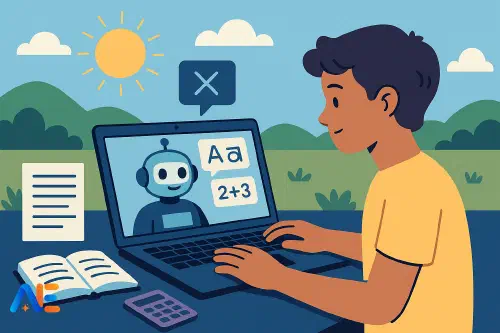
AI-powered tutoring is emerging as one such option. It is not a magic solution, but if we borrow what works from human tutoring research and apply it carefully, it can help reduce summer slide in a realistic way.
For a broader look at AI in holiday provision, you might also find this piece on AI in summer school models useful.
What the research says on tutoring
Before we talk about AI, it helps to be clear about what makes tutoring effective in the first place. Large-scale studies of “high-impact tutoring” highlight several consistent features.
Tutoring works best when it is frequent, focused, and connected to the curriculum pupils will meet next. Short, regular sessions – for example, three times a week for 30 minutes – tend to beat occasional long blocks. The most effective programmes are tightly linked to classroom content and assessment, rather than generic “extra practice”.
Group size matters too. One-to-one and very small group tutoring usually show the largest gains, particularly in maths and early literacy. Importantly, tutoring that targets specific gaps, rather than reteaching everything, is more efficient and less demotivating.
Finally, relationships and feedback are central. Skilled tutors give immediate, specific feedback, adjust difficulty as pupils respond, and encourage persistence. They also monitor understanding closely, so misconceptions are caught early rather than becoming entrenched.
These principles should guide how we design AI-supported summer interventions. The technology is new; the underlying learning science is not.
From human to AI: what carries, what changes
AI tutors can now mimic some aspects of high-impact tutoring at scale, but they are not a straight replacement for a skilled adult. The art is to carry across the strengths while respecting the limits.
Personalised practice is one of the strongest carry-overs. AI tools can adapt questions in real time, offering easier or harder tasks as pupils respond. Features like a built-in difficulty adjuster – similar in spirit to the ideas discussed in our article on adaptive challenge in AI tools – can help maintain an optimal level of challenge without teacher micromanagement.
Immediate feedback also translates well. An AI tutor can explain why an answer is incorrect, model a worked solution, and then provide a follow-up question to check understanding. This can be particularly powerful in subjects such as algebra, grammar, or science calculations.
However, some things change. AI cannot pick up subtle emotional cues, notice when a child is simply exhausted, or fully replace the motivation that comes from a trusted adult. It may also “hallucinate” – confidently give incorrect information – if not well constrained or monitored.
So the goal is not to hand pupils over to AI, but to use AI tutors as structured practice partners within a human-led framework. Teachers still decide what matters, set boundaries, and interpret the data that comes back.
Designing an AI summer strategy
If your school cannot run a full summer programme, an AI-supported strategy can still be coherent and purposeful rather than ad hoc. Think in terms of three layers: focus, format, and follow-up.
First, clarify your focus. Which subjects and year groups are most at risk of summer loss? For many schools, that means numeracy in upper primary and lower secondary, reading fluency and comprehension in early years and primary, and key exam classes. Choose a small number of priorities rather than trying to cover everything.
Second, decide on formats that match your capacity. Common models include:
- Take-home AI tutors: pupils use a recommended AI platform for short, regular sessions at home.
- Short online clinics: teachers run one or two live online sessions a week, with pupils using AI tutors for guided practice during or after the session.
- On-site “drop-in” hours: for schools that can open for limited days, pupils access AI tutoring in a supervised space with minimal staffing.
Third, plan follow-up. How will you use summer learning data in the first weeks of the new term? Which classes or pupils will you check in with first? Building this into your planning helps ensure the summer effort translates into classroom impact.
If you are still building staff confidence with AI, you might pair this with some light-touch professional learning, drawing on ideas from our piece on AI training for educators.
Discover the power of Automated Education by joining out community of educators who are reclaiming their time whilst enriching their classrooms. With our intuitive platform, you can automate administrative tasks, personalise student learning, and engage with your class like never before.
Don’t let administrative tasks overshadow your passion for teaching. Sign up today and transform your educational environment with Automated Education.
🎓 Register for FREE!
Practical use cases by subject
The most effective summer AI tutoring is concrete, not vague. Pupils need clear, achievable tasks that link to what they have just learned or will meet next.
In maths, you might set a “summer essentials” pathway for each year group. For example, Year 7 pupils could complete short AI-guided sessions on fractions, negative numbers, and word problems, three times a week. The AI tutor offers step-by-step scaffolding, checks working, and adjusts difficulty. Teachers, in turn, review summary reports to spot common misconceptions before September.
For reading, an AI tutor can support daily reading with light-touch comprehension prompts. Pupils read a short text, then answer questions that probe inference, vocabulary, and main ideas. The AI can rephrase tricky sentences, generate simpler explanations, or propose follow-up questions. Combined with guidance on choosing appropriate books, this can help maintain fluency and comprehension habits.
In science, AI tutors can help pupils revisit key concepts that often fade over the summer, such as forces, energy, or cell structure. Short, scenario-based questions with immediate explanations work well here. For older pupils, AI can guide them through exam-style questions, modelling how to unpack command words and structure answers.
Accessibility matters too. Many AI tools now support text-to-speech, translation, and adjustable reading levels, which can make summer work more inclusive. Our article on lesson accessibility features explores some of these options in more detail.
Equity, safety, and screen balance
Any summer AI plan needs clear guardrails to remain ethical and sustainable. Begin with equity. Not all families have reliable devices or connectivity. Consider lending devices, providing printed backup tasks that mirror the AI activities, or offering supervised access at school or community centres, even if only for a few hours each week.
Safeguarding and data protection are non-negotiable. Choose platforms that comply with your local data regulations, avoid unnecessary data collection, and allow you to disable open-ended chat if needed. Make sure pupils cannot access inappropriate content through the AI interface, and that chat histories are visible to staff if concerns arise.
Screen time is another concern. Position AI tutoring as a short, focused daily habit – perhaps 15–25 minutes – rather than an open-ended digital playground. Encourage families to balance AI practice with offline reading, outdoor play, and creative activities. Clear guidance such as “three short AI sessions and three offline reading sessions per week” can help keep expectations concrete and manageable.
Working with families
Family buy-in is often the difference between summer plans that work and those that quietly disappear. Keep communication simple and positive. Explain that the goal is not to give children “more school”, but to protect the progress they have already made.
Provide step-by-step instructions for logging in, model a sample session with screenshots, and suggest routines that fit different contexts. For example, some families might prefer a quick session after breakfast; others might build it into an existing homework slot.
It can help to give families a short list of prompts they can use to talk to their child about AI sessions, such as “What was one thing you found easier today than last week?” or “What mistake did you learn from in today’s maths practice?” This keeps the focus on effort and learning, not just scores.
Reassure families that teachers will use the summer data to support pupils, not to judge them. The message should be: “Anything you can manage will help us help your child in September.”
Planning for autumn
The final step is to connect summer activity with autumn teaching. Before term starts, identify a small set of indicators you will look at from the AI platform: perhaps completion rates, most-missed question types, or progress in key skills.
Use this information to shape your first few weeks. You might plan quick diagnostic tasks that mirror the AI work, group pupils for targeted revision sessions, or adjust the pace of new content. For classes that engaged heavily with the AI tutor, you could build on their familiarity with the tool for in-class practice.
Importantly, reflect on what worked and what did not. Which pupils engaged most? Which formats were sustainable for staff? Treat the first summer as a pilot, and refine your approach year by year.
Handled thoughtfully, AI-powered tutoring can become a practical, low-prep part of your strategy to reduce summer learning loss, even when full programmes are out of reach. The key is to ground it in what we already know about effective tutoring, keep humans firmly in the loop, and design with equity and balance in mind.
Happy summer tutoring!
The Automated Education Team