From pilots to policy
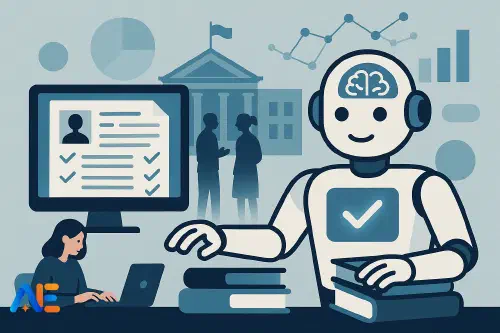
Universities moved first on AI-assisted marking largely out of necessity. Class sizes grew, feedback expectations increased, and staff workload reached unsustainable levels. At the same time, large language models suddenly made it possible to automate parts of the marking process that previously required human judgement.
Early pilots often focused on low-stakes assessments: weekly quizzes, lab reports, short-answer questions. These trials aimed to answer two questions. First, could AI-generated feedback be accurate and pedagogically sound? Second, could it save staff time without undermining academic standards?
Once departments saw that AI could reliably pre-mark or generate draft feedback, senior leaders began to formalise practice. Policies emerged that framed AI as “marking support” rather than “automatic grading”. In almost every case, humans remained the final arbiters of grades, but AI started to handle the heavy lifting of first-pass review, feedback drafting and consistency checking.
For schools, this evolution from small pilot to policy is instructive. You do not need to start with high-stakes exams. Instead, you can begin with homework, practice essays or internal assessments, and only later consider more formal use once you have evidence that your processes are robust.
What AI-assisted marking looks like
In higher education, AI-assisted marking typically sits within existing learning platforms rather than replacing them. A common pattern has emerged.
A lecturer uploads a rubric and a set of model answers or annotated exemplars. Students submit work as usual. The AI then analyses each submission, aligns it with the rubric and generates:
- A provisional mark or band
- Structured comments for each criterion
- Suggestions for feedforward: next steps or targeted practice
The human marker sees a dashboard view. Instead of starting from a blank screen, they review and edit the AI’s proposed comments and mark. They can override the AI entirely, but in many cases they simply refine wording or adjust borderline decisions.
Some universities use AI for “marking the marking”. The AI compares markers’ decisions across a cohort, flagging anomalies such as unusually generous or harsh marking, or inconsistent application of criteria. This helps course leaders decide where to focus moderation.
Schools can mirror this pattern on a smaller scale. AI can propose comments on a set of Year 10 essays, while the teacher retains full control of the final mark. Or it can scan a class set of science reports, highlighting those that may need a closer look because they deviate from the rubric in unexpected ways.
Governance and quality assurance
Universities have been careful to keep humans in charge, and they have built governance structures to prove it. Policies usually specify:
- AI may draft feedback and provisional marks
- Human markers must review and approve all grades
- AI tools must be documented, approved and periodically audited
Some institutions run “parallel marking” studies. A sample of scripts is marked twice: once with AI support and once without. Differences are analysed to detect systematic bias or quality issues. Where the AI underperforms, its role is scaled back or retrained.
Quality assurance committees also insist on clear documentation: how the AI is configured, what data it uses, and how staff are trained. External examiners are often briefed on AI’s role so they can scrutinise outcomes properly.
For schools, similar principles apply, even if structures are lighter. A simple internal policy can clarify that AI supports teacher judgement rather than replaces it. You might align this with your broader AI acceptable use policy, so staff understand where marking support sits within your overall approach.
Moderation, calibration and bias
University marking teams have found that AI works best when integrated into existing moderation and calibration routines, not bolted on afterwards.
Before large-scale use, markers often run calibration exercises. They mark a small set of scripts, compare decisions, and then see how the AI would have scored the same work. This three-way comparison (marker A, marker B, AI) surfaces discrepancies and helps refine both human and AI interpretations of the rubric.
Bias is a constant concern. Some universities anonymise scripts before AI processing, removing names and demographic details. Others test the system on diverse exemplars, checking whether similar-quality work receives similar feedback regardless of context or writing style.
Schools can adopt simpler versions of this. For example, a department might:
- Agree a set of anchor scripts with agreed marks
- Run them through the AI and see where it diverges
- Adjust prompts, rubrics or usage rules accordingly
This deliberate calibration helps ensure the AI reinforces, rather than undermines, your shared understanding of standards.
Student trust and transparency
Where universities have succeeded, they have been unusually transparent with students. They explain that AI may help generate feedback, but that staff retain responsibility for grades. Some institutions even show side-by-side views: the AI’s draft and the lecturer’s final version, to demonstrate human oversight.
Students are usually reassured when they see that AI is being used to provide more timely, detailed feedback, not to cut corners. They are less comfortable if they feel decisions are being made by a black box.
In schools, the same principle holds. Be clear with pupils and families about:
- Where AI is used (for example, drafting formative feedback)
- Where it is not used (for example, final exam grades)
- How teachers review and adjust AI outputs
Linking this to wider conversations about when AI helps and when it harms learning can be powerful. You might draw on ideas from this exploration of AI’s impact on learning to frame those discussions.
Workload, wellbeing and unions
Staff workload and wellbeing have been central themes in university adoption. Many academics were initially wary, fearing automation of their expertise. Unions often raised concerns about job security, surveillance and deprofessionalisation.
Successful institutions addressed these head-on. They positioned AI as a tool for reducing administrative burden, not replacing academic judgement. They involved staff in pilot design, gathered honest feedback, and allowed opt-out routes during early stages. Some negotiated formal agreements with unions, specifying that AI would not be used for performance management or to replace posts.
For schools, especially where unions are influential, early engagement is crucial. Demonstrate that AI marking support is intended to:
- Free time for richer feedback conversations
- Reduce repetitive commenting
- Support consistency, especially for early-career teachers
Involve staff representatives in choosing tools, designing workflows and defining red lines. This shared ownership will matter more than any technical feature.
Discover the power of Automated Education by joining out community of educators who are reclaiming their time whilst enriching their classrooms. With our intuitive platform, you can automate administrative tasks, personalise student learning, and engage with your class like never before.
Don’t let administrative tasks overshadow your passion for teaching. Sign up today and transform your educational environment with Automated Education.
🎓 Register for FREE!
Translating practice into school workflows
The key lesson from universities is to embed AI within existing assessment systems, not build parallel processes.
In a typical secondary school, you might start with three workflows:
First, AI-assisted formative feedback. Teachers upload a rubric and a few exemplars. Students submit drafts of essays or reports. The AI generates structured feedback, which the teacher quickly reviews and edits before sharing. Marks remain entirely teacher-assigned.
Second, AI-supported moderation. After teachers have marked a class set of work, they run anonymised scripts through the AI to highlight potential inconsistencies. This does not change marks automatically, but it gives heads of department a targeted list of scripts to double-check.
Third, AI for common comments. The AI helps generate a bank of frequently used comments aligned with your rubrics. Teachers then select and adapt these when marking, speeding up the process while maintaining personalisation.
Each of these workflows can be piloted in one subject or year group, then refined before wider roll-out.
Designing AI-ready rubrics and templates
Universities have learnt that vague rubrics confuse AI models just as much as they confuse students. Criteria like “good understanding” are hard to interpret consistently. Instead, they increasingly use more specific descriptors linked to observable features of the work.
Schools can follow suit by designing AI-ready rubrics that also benefit human markers. For example, a writing rubric might distinguish between “uses a range of sentence structures accurately” and “uses mostly simple sentences with some errors”. These concrete descriptors give the AI something to latch onto and make moderation easier.
Feedback templates also matter. Many universities now structure feedback under headings such as “What you did well”, “Areas to improve” and “Next steps”. AI can populate these sections with draft comments, which teachers then refine. This structure is equally helpful in schools, especially for pupils who struggle to act on unstructured feedback.
If you are redesigning assessments anyway, you may also want to consider how to make them more resilient to AI-generated student work, drawing on ideas from designing AI-resilient assessments.
Safeguarding, data and exam boards
University systems usually sit within robust data governance frameworks, but schools must be especially cautious. Several constraints shape what is possible.
First, safeguarding: pupil work can include sensitive personal information. Any AI tool you use for marking must handle data securely, with clear data processing agreements and no use of pupil work for model training without explicit consent.
Second, data protection: ensure that any transfer of scripts to AI services complies with local data laws. Pseudonymisation or anonymisation is often wise, particularly for high-stakes work.
Third, exam-board rules: in many systems, external exams and controlled assessments have strict regulations about the use of digital tools. AI-assisted marking may be perfectly acceptable for internal assessments but prohibited for certain components. Schools need a clear map of where AI can and cannot be used, and this should be reflected in your policies and staff training.
These safeguards should sit alongside your broader ethical stance on AI in assessment, including how you approach issues like AI detection, as explored in this article on AI detection ethics.
A phased roadmap for schools
Drawing on university experience, a pragmatic roadmap for schools might look like this.
Phase one focuses on exploration. A small group of interested teachers experiment with AI-assisted feedback on low-stakes tasks, using anonymised work where possible. They document benefits, problems and student reactions.
Phase two moves to structured pilots. One or two departments adopt agreed workflows, such as AI-drafted feedback or moderation support, with clear success criteria and opt-out options. Leaders gather evidence on time saved, quality of feedback and staff wellbeing.
Phase three formalises policy. The school defines where AI can be used in marking, how human oversight is ensured, and what training staff receive. This policy aligns with wider digital and AI strategies, and is communicated clearly to students and families.
Phase four considers scaling. Successful workflows are extended across year groups and subjects, always respecting exam-board rules and safeguarding requirements. Regular reviews check for drift, bias or unintended consequences, and the school remains open to adjusting or rolling back practices that do not serve learners.
Throughout, the guiding principle mirrors that of universities: AI should amplify professional judgement, not replace it. When used thoughtfully, it can help teachers spend less time on repetitive marking and more time on the rich, relational work that only humans can do.
Happy marking!
The Automated Education Team