What is OpenAI o1?
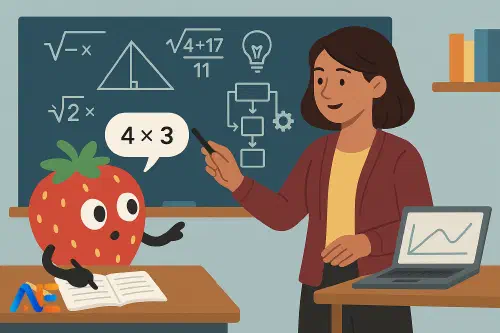
OpenAI o1 (codenamed “Strawberry”) is a new type of model designed to reason before it replies. Instead of giving the fastest plausible answer, it spends more time “thinking” step by step, then summarises that internal reasoning into a response.
In plain language, o1 behaves more like a diligent student working through a problem on paper than a pupil blurting out the first idea that comes to mind. It pauses, drafts intermediate steps, sometimes uses tools such as code or calculators, and then gives you its conclusion.
You will still chat to o1 much as you do with GPT‑4o. The difference is what happens in the background. Where GPT‑4o optimises for speed and fluency, o1 is optimised for deliberate problem‑solving, especially in subjects like mathematics, science, logic and complex multi‑step tasks.
For teachers, that means o1 is less about “instant answers” and more about “showing the working”, supporting reasoning and helping students see how to get from question to solution.
If you are new to OpenAI models more generally, you may find it helpful to compare with GPT‑4o first in our overview of GPT‑4o for classrooms, then return to o1 as the next step.
How reasoning‑first differs from GPT‑4o
Earlier GPT models, including GPT‑4o, are excellent at language: drafting, explaining, translating, summarising and generating creative tasks. They can reason, but they were not primarily built for slow, deliberate thinking.
Reasoning‑first models like o1 change the order of priorities. They are designed to:
- spend more “compute” on internal chains of thought
- use tools (like code execution) more strategically
- trade speed and style for accuracy on complex reasoning tasks
In practice, the difference looks like this.
A teacher asks GPT‑4o: “Explain why this probability solution is wrong.” GPT‑4o will often give a fluent explanation, but it may skip over subtle errors or quietly accept a flawed premise.
Ask o1 the same question and you are more likely to see a response that:
- reconstructs the whole problem
- checks assumptions more carefully
- walks through the incorrect method line by line
- offers a corrected solution with clear steps
You may notice o1 taking a little longer to respond, especially on challenging questions. That delay is the “slow thinking” phase, similar to a student scribbling in a rough book before writing a neat answer.
This also means o1 is often better suited to tasks that demand robust reasoning, while GPT‑4o remains very strong for everyday drafting, lesson resources and quick explanations. Many schools will end up using both: GPT‑4o for general‑purpose teaching tasks, o1 for high‑stakes reasoning and checking.
For a broader comparison of leading models in education, you can also see our AI buyers’ guide for schools.
Strengths and limits that matter
O1’s strengths line up closely with many school needs. It is particularly good at:
- multi‑step maths and science problems, including proofs and derivations
- analysing students’ reasoning, not just their final answers
- planning complex sequences, such as long projects or schemes of work
- checking logic in arguments, essays and explanations
However, it still has important limits.
First, it can still be confidently wrong. The extra reasoning reduces errors but does not eliminate them. Teachers should treat o1 as an assistant to review, not an oracle to trust blindly.
Second, o1 may be slower and slightly less “chatty” than GPT‑4o. In a busy classroom, that latency matters. You might use GPT‑4o for quick in‑lesson queries, and o1 for deeper work during planning or marking.
Third, like all current models, it does not have genuine understanding or access to your specific curriculum unless you provide that context. You must still check alignment with your syllabus, local assessment objectives and school policies.
Finally, o1’s strong reasoning makes it more powerful for misuse in unsupervised assessments. It can complete complex exam‑style questions with convincing working, which raises the stakes for academic integrity.
Classroom examples: modelling reasoning
The most exciting use of o1 in classrooms is as a “reasoning partner” that makes thinking visible.
Imagine a Year 10 maths teacher preparing a lesson on simultaneous equations. They ask o1:
“Solve this pair of equations step by step, and narrate your reasoning like a student who is thinking aloud. Then provide two common incorrect approaches and explain why they fail.”
O1 can generate a complete worked solution, plus two realistic wrong methods with commentary. The teacher turns these into a starter activity: pupils identify which solution is correct, annotate the errors and then compare with the AI’s reasoning.
In science, a teacher might paste a student’s explanation of a physics problem and ask:
“Analyse this explanation. Identify each reasoning step, label whether it is valid or not, and suggest one targeted question I could ask the student to move them forward.”
O1’s response can help the teacher plan probing questions, rather than just correcting the final answer.
In humanities, you might use o1 to model metacognition. For example:
“Here is an exam question in history. First, plan a high‑quality answer using bullet points and justify each choice. Then write the answer, pausing after each paragraph to explain why you structured it that way.”
Students read both the essay and the “thinking notes”, then try writing their own responses with similar self‑commentary. Over time, they internalise that reflective process.
You can also ask o1 to generate “thinking scripts” for specific strategies, such as how to approach an unfamiliar text in a new language, or how to check your answer in algebra before submitting it.
Discover the power of Automated Education by joining out community of educators who are reclaiming their time whilst enriching their classrooms. With our intuitive platform, you can automate administrative tasks, personalise student learning, and engage with your class like never before.
Don’t let administrative tasks overshadow your passion for teaching. Sign up today and transform your educational environment with Automated Education.
🎓 Register for FREE!
Assessment and feedback with o1
O1’s deliberate reasoning makes it especially useful for assessment design, marking support and moderation.
For worked solutions, a teacher can paste a multi‑step exam question and ask:
“Produce a model solution that would earn full marks under these criteria, and annotate each step with the specific mark it would receive.”
The teacher can then refine the wording, adjust to their mark scheme, and share it with students as part of feedback or revision materials.
For marking support, you might take a sample of student scripts (with names removed) and ask o1:
“Using this mark scheme, provide a proposed mark for each script. For each one, explain your reasoning using the language of the criteria, and flag any borderline decisions that would benefit from human moderation.”
This can speed up your own thinking without replacing your judgement. You remain the marker, but o1 helps you articulate and check your reasoning.
For moderation, departments could use o1 to stress‑test grade boundaries. For example:
“Given this set of borderline essays and our grade descriptors, suggest which are more securely at Grade B and which are closer to Grade C. Explain your decisions and identify any inconsistencies in our descriptors.”
The aim is not to let the AI decide grades, but to surface tensions and ambiguities so that humans can resolve them.
For more on designing assessments that remain robust in an AI‑rich world, see our guide on AI‑resilient assessment design.
Safeguarding, exams and integrity
Because o1 is better at reasoning, it is also better at cheating. A student can paste a multi‑part exam question and receive not only the answer but convincing working and explanations.
This raises three key issues.
First, unsupervised take‑home tasks that rely heavily on reasoning are now more vulnerable. Schools may need to shift some high‑stakes assessment back into supervised settings, or redesign tasks so that AI support is either allowed and transparent, or genuinely limited.
Second, you will need clearer guidance on acceptable use. For example, you might allow students to use o1 to generate alternative explanations or to check their reasoning, but prohibit using it to produce complete solutions for graded homework.
Third, staff must understand that “AI detectors” are unreliable, especially with advanced models. Focus instead on assessment design, dialogue with students and patterns of work over time.
It is also important to consider safeguarding. As with any AI tool, ensure that:
- access is age‑appropriate and filtered
- logging and monitoring align with your safeguarding policies
- students know how to report harmful or inappropriate outputs
Our article on when AI helps vs harms learning offers a useful framework for deciding when to encourage or limit AI use in particular tasks.
Rollout tips for leaders and IT
For school leaders and IT teams, o1 should not simply be “switched on for everyone” without planning.
Start with a small pilot group of staff across different subjects, including at least one assessment lead. Give them time to explore o1 for planning, feedback and moderation, and ask them to document concrete use cases and pitfalls.
Ensure access runs through managed, auditable accounts, not personal logins. Clarify data protection arrangements, including what is and is not logged or stored.
Develop simple, subject‑specific exemplars: two or three “approved” ways to use o1 in each department, plus examples of what not to do. This helps staff who are less confident with technology see immediate value without feeling overwhelmed.
Finally, integrate o1 into existing digital literacy and academic integrity policies, rather than treating it as a separate issue. The core principles around honesty, attribution and responsible use remain the same; the tools have simply become more capable.
Talking to staff, students and parents
Communication will shape how o1 is received in your community.
With staff, emphasise that o1 is designed to support professional judgement, not replace it. Show how it can reduce cognitive load in planning and marking, while also deepening students’ exposure to high‑quality reasoning.
With students, be explicit about what is allowed. Show examples of “good” AI use, such as checking an approach or generating alternative explanations, and “poor” use, such as submitting AI‑generated working as their own.
With parents, explain both the opportunities and the risks. Reassure them that the school is not outsourcing teaching to AI, but using tools like o1 to enhance feedback, personalise support and keep assessments meaningful in a changing landscape.
Short, concrete examples work best: a screenshot of an AI‑annotated solution, or a side‑by‑side comparison of a student’s draft and their improved version after using o1 as a reasoning coach.
What to watch next
Reasoning‑first models like o1 are likely to become a new category of educational technology. Over the next few years, we can expect:
- deeper integration into learning platforms and assessment systems
- more subject‑specific reasoning models tuned to particular curricula
- better tools for teachers to inspect and shape the model’s internal “thinking”
For educators, the key shift is cultural as much as technical. We are moving from AI as a “text generator” to AI as a “thinking partner”. That creates powerful opportunities for modelling metacognition, exposing hidden steps in problem‑solving and supporting more consistent assessment.
At the same time, it demands more thoughtful assessment design, clearer integrity policies and ongoing professional learning. OpenAI o1 is not the final destination, but it is an important milestone: the first widely accessible reasoning‑first model that schools need to understand.
Used carefully, it can help teachers and students focus less on copying answers and more on understanding how good thinking actually works.
Happy reasoning!
The Automated Education Team