Why support needs more than translation
Many multilingual learners experience mainstream lessons as a blur of unfamiliar words, rapid explanations and half-understood tasks. Even when they have access to translation apps, those tools usually act as a crutch rather than a scaffold. They convert sentences into a more familiar language, but they do not build the academic English needed to access exams, textbooks and classroom talk.
Translation also breaks the flow of learning. A pupil toggling between a worksheet and a translation app is constantly switching attention, often missing the teacher’s next explanation. Worse, subject-specific terms such as “photosynthesis”, “alliteration” or “trade deficit” are frequently mistranslated or oversimplified.
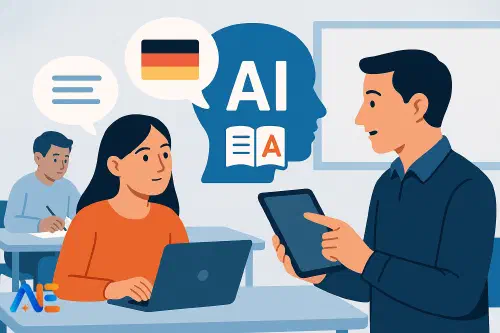
AI can help, but only if we use it for more than “translate this”. When used thoughtfully, AI becomes a live language assistant sitting alongside your teaching. It can simplify texts without dumbing them down, generate quick glossaries tied to your lesson, and provide extra listening practice using your own explanations. The key is to keep the classroom teacher in charge, with AI offering responsive scaffolds for vocabulary and comprehension.
For a broader view of how AI can break down language barriers, you might like to read this guide alongside the practical ideas below.
Principles for using AI with multilingual learners
Before diving into prompts, it helps to anchor practice in a few principles that work across subjects and age ranges.
First, AI should add clarity, not confusion. Any support it generates must be shorter, simpler and better organised than the original material. If the AI output feels longer or more complex, it is not a scaffold.
Second, preserve key academic language. The aim is not to avoid challenging vocabulary but to surround it with support: definitions, examples, visuals and sentence frames. Learners need to meet “evaporation” and “symbolism”, not have them quietly replaced.
Third, keep tasks intellectually demanding. AI should not give away answers or complete work for pupils. Instead, it can offer hints, model partial answers, or break tasks into stages. This aligns with wider thinking on when AI helps versus harms learning.
Finally, build independence over time. Early on, pupils may need heavy scaffolding. As confidence grows, you can gradually reduce AI support, encouraging learners to attempt more complex texts and explanations before seeking help.
Scaffolding tasks: prompts and routines
Subject teachers often worry they do not have time to create separate EAL resources. AI can bridge that gap by adapting what you already have, almost in real time.
Imagine you have a slide explaining plate tectonics. Before the lesson, you paste your explanation into an AI tool and ask:
“Rewrite this explanation so a 12-year-old new to English can understand it. Keep the key scientific words, but use shorter sentences and everyday examples. Provide a short glossary at the end.”
You now have a simplified version and a glossary that can be printed, shared on a device or displayed next to the original slide. During the lesson, the learner follows the same teaching as everyone else, but with a personalised scaffold at hand.
You can use similar routines for written tasks. When setting an extended response, ask AI to create two or three sentence starters and a model paragraph with some gaps. Share these only with learners who need them, making it clear that they are support, not shortcuts.
For more on balancing support and challenge across your class, you may find it helpful to explore this article on differentiation with AI.
Building vocabulary with AI
Vocabulary is often the biggest barrier in mainstream lessons. AI can turn your existing word lists into richer language experiences without requiring hours of preparation.
Start with the key terms for your topic. Paste them into an AI tool and request:
“Create a learner-friendly definition, one everyday example, and one subject-specific example for each word. Then write a gap-fill sentence for each that a 13-year-old EAL learner could complete.”
You now have a mini vocabulary pack ready for starters, homework or quick in-class checks. You can also ask AI to sort words into groups such as “verbs of analysis” or “emotions in literature”, helping learners see patterns.
To go further, use AI to generate short dialogues that include your target words. For example, in a history lesson on revolutions, you might ask for a conversation between two pupils discussing why people rebel, using words like “protest”, “rights”, “government” and “unfair”. Reading or acting out the dialogue gives learners repeated, contextualised exposure to key terms.
AI can also support first-language connections. If appropriate, you might ask for a table with the English word, a simple English definition, and space for the pupil to add a translation in their home language. Crucially, the AI provides the English support; the learner or family adds the translation, keeping them actively involved.
Discover the power of Automated Education by joining out community of educators who are reclaiming their time whilst enriching their classrooms. With our intuitive platform, you can automate administrative tasks, personalise student learning, and engage with your class like never before.
Don’t let administrative tasks overshadow your passion for teaching. Sign up today and transform your educational environment with Automated Education.
🎓 Register for FREE!
Supporting reading without giving answers
Long reading tasks can be daunting for learners still developing English. Rather than replacing the text with a simplified version, AI can sit alongside it as a reading companion.
One effective strategy is to create “pre-questions”. Paste your text into an AI tool and ask:
“Generate five simple preview questions that help a learner know what to look for in this text. Do not give the answers.”
Pupils read with a purpose, scanning for ideas rather than getting stuck on every word. You can also ask AI to identify potentially tricky sentences and rephrase them, while keeping the original paragraph intact. Learners can then compare the two versions, using the simpler one to unlock the more complex.
Another approach is to create tiered summaries. Ask for a three-sentence summary, then a one-sentence summary, then three key words to remember. These can be used as checkpoints during reading, not as substitutes for it.
This approach mirrors broader inclusive strategies used with other learners who need scaffolding, such as those with SEND. For a wider perspective, see AI for SEND: beyond personalisation.
Listening and speaking confidence
Listening in a second or additional language is exhausting, especially when the content is new. AI can help by turning your core explanations into repeatable, controllable listening practice.
After a lesson, you might paste a short explanation you used in class into an AI tool and ask it to produce an audio version at a slower pace, with clear pauses between sentences. Many platforms can generate speech directly; if not, you can copy the text into a separate text-to-speech tool. Learners can replay this at home or during independent work, pausing to note key words.
For speaking, AI can provide low-pressure rehearsal. For instance, before a pupil gives a short presentation on a science experiment, you might ask AI:
“Create a simple script for a 10-year-old EAL learner describing this experiment in 5–6 sentences, with key science words included.”
The learner practises with the script, then gradually moves away from reading it word for word. You can also generate question prompts at different difficulty levels, allowing them to rehearse possible answers.
Low-prep workflows across subjects
The most sustainable AI use comes from repeatable workflows that fit into your existing planning habits. You do not need a new routine for every topic.
One workflow might be “pre-lesson scaffold”: every time you create a new explanation slide or worksheet, you spend three minutes generating a simplified version and glossary. Another might be “vocabulary pack”: at the start of each unit, you feed your key terms into AI and produce definitions, examples and practice questions.
You can adapt these workflows across subjects and ages. A primary teacher might use them to support story retells and basic science concepts. A secondary teacher might apply the same patterns to algebra, geography case studies or exam-style questions. Over time, you build a bank of AI-assisted scaffolds that can be reused and refined.
Safeguards, equity and collaboration
As with any digital tool, safeguards matter. Multilingual learners may be less able to spot errors or inappropriate content in AI output, so adult oversight is essential. Always skim-read AI-generated materials before sharing them, and avoid asking learners to paste personal information or full essays into public tools.
Equity is another concern. If only some pupils have devices or reliable internet access, design activities so that AI support is teacher-mediated rather than device-dependent. For example, you can print AI-generated glossaries or display simplified explanations on the board, ensuring everyone benefits.
Working with families and support staff can enhance impact. Share some of your AI-generated vocabulary sheets with bilingual assistants or parents, inviting them to add translations or examples from home contexts. This reinforces the message that AI is one tool among many, not a replacement for human relationships and expertise.
Quick start: 10 prompts for tomorrow
To get going, copy and adapt any of these, adding your own text or topic where indicated:
- “Rewrite this explanation for a 12-year-old new to English. Keep key subject words, use short sentences and everyday examples: [paste text].”
- “Create a glossary for these words with simple definitions and one example each, suitable for a 14-year-old EAL learner: [list words].”
- “Identify five sentences in this text that may be hard for EAL learners. Rephrase each in simpler English while keeping the meaning: [paste text].”
- “Write five preview questions to guide reading of this text. Use simple language and do not include answers: [paste text].”
- “Make a three-sentence and a one-sentence summary of this passage for a learner still developing English: [paste text].”
- “Create a short dialogue between two pupils using these key words in context, suitable for 11-year-olds: [list words].”
- “Generate sentence starters to help a 15-year-old EAL learner answer this exam-style question in my subject: [paste question].”
- “Write a simple script (6–8 sentences) for a pupil explaining this concept aloud, including key technical terms: [describe concept].”
- “Turn this success criterion into a checklist with simple language for an EAL learner: [paste criteria].”
- “Suggest three quick in-class activities to practise these words with EAL learners in a mainstream lesson: [list words].”
Used thoughtfully, these prompts can help your multilingual learners participate more fully in everyday lessons, building both language and subject understanding side by side.
Happy scaffolding!
The Automated Education Team