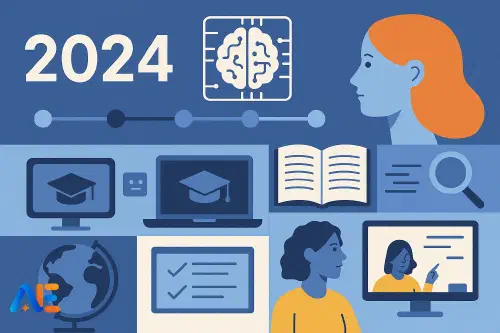
Introduction: why 2024 mattered
Across 2024, AI in education quietly shifted from novelty to infrastructure. At the start of the year, many schools were still debating whether to “allow” AI. By the end, leaders were asking deeper questions: where should we rely on AI, where must we restrict it, and how do we build staff and student capability rather than chasing every new tool?
This review is not a generic technology recap. It focuses on the AI developments that actually started to change teaching, learning and school operations, and it keeps a clear eye on what matters for 2025 rather than what simply made headlines.
If you want a longer view of how fast things have moved since late 2022, you might also enjoy our reflection on two years of generative AI in schools.
How to use this timeline
This is a month‑by‑month overview of 2024’s major AI‑in‑education moments: new models, tools, policies and research. For each, you will see a short “So what for classrooms?” call‑out to keep the focus on practice.
You might use it in three ways. First, as a briefing tool for leadership and governors: what changed, and why your strategy may need updating. Second, as a discussion starter with staff and student councils about how AI is already shaping learning. Third, as a planning map for 2025: which trends demand action, which deserve cautious experimentation, and which can be safely parked.
January–March: from hype to guardrails
January: policy catch‑up begins
Several governments and regional authorities opened 2024 by issuing interim guidance on generative AI in education. These documents did not settle every question, but they signalled a shift from blanket bans towards risk‑managed use, emphasising data protection, academic integrity and teacher professional judgement.
So what for classrooms? The early policies legitimised thoughtful experimentation. Many schools began piloting AI for lesson planning, translation and SEND support under clearer rules, rather than leaving staff to work in the shadows.
February: multimodal becomes normal
By February, major AI platforms had rolled out more robust multimodal features: analysing images, reading PDFs, and generating diagrams or slide outlines. Teachers started to upload worksheets, exam papers and schemes of work to get rapid differentiation ideas, model answers and vocabulary scaffolds.
So what for classrooms? Multimodal capability made AI far more useful for busy teachers, but also raised new safeguarding and copyright questions. Schools that updated their acceptable use policies and trained staff to strip personal data from uploads were better placed to benefit.
March: first big integrity push of the year
As exam seasons loomed in many regions, universities and school systems published new academic integrity frameworks for AI. There was growing recognition that traditional plagiarism detection tools were unreliable for AI‑generated text, and a shift towards assessment design that reduced opportunities for unacknowledged AI use.
So what for classrooms? The most practical response was assessment redesign: more in‑class writing, oral explanations, process portfolios and transparent “AI‑assisted” tasks. Schools that treated this as an opportunity to improve assessment, rather than just a threat, made real gains.
April–June: models, open source and policy signals
April: faster, cheaper models arrive
In April, several vendors released more efficient versions of their flagship models, with lower costs and faster responses. For education, this mattered less as a technical milestone and more as a budget issue: AI‑powered features became viable inside mainstream learning platforms, MIS systems and assessment tools, not just specialist pilots.
So what for classrooms? AI started to appear “under the bonnet” of tools teachers already used, from quiz generators to behaviour logging systems. The shift was from “using ChatGPT” to “my usual platform now has an AI button”.
May: open source gains momentum
Mid‑year saw a surge in capable open‑source models, including smaller language models that schools or edtech providers could host privately. This was particularly significant in regions with strict data localisation rules or limited budgets for premium AI subscriptions.
So what for classrooms? Open‑source options widened access and supported experimentation in local languages and curricula. For school leaders, the key question became: do we want to rely entirely on big commercial ecosystems, or to support partners who can adapt AI more locally?
June: clearer national strategies
By June, a number of countries had published or updated national AI in education strategies. Common themes included teacher professional development, infrastructure investment, safeguarding and equity. Many emphasised the need for critical AI literacy, not just digital skills, for both staff and students.
So what for classrooms? These strategies legitimised time for training and experimentation. Where systems backed their words with funding and workload protection, schools could move from ad‑hoc tinkering to planned, whole‑school approaches.
Discover the power of Automated Education by joining out community of educators who are reclaiming their time whilst enriching their classrooms. With our intuitive platform, you can automate administrative tasks, personalise student learning, and engage with your class like never before.
Don’t let administrative tasks overshadow your passion for teaching. Sign up today and transform your educational environment with Automated Education.
🎓 Register for FREE!
July: reasoning and planning models mature
New “reasoning‑focused” models, designed to handle multi‑step problems and planning tasks, became widely available over the summer. For education, this meant more reliable support for complex lesson sequencing, curriculum mapping and multi‑stage student feedback.
So what for classrooms? Teachers started to lean on AI not just for quick ideas, but for draft schemes of work, progression pathways and multi‑lesson projects. The risk, of course, was over‑reliance: schools that insisted on human review and local adaptation saw the best results.
Several new tools launched with AI at their core rather than bolted on. Examples included platforms that auto‑generate retrieval practice from existing resources, tools that draft personalised feedback comments at scale, and planning assistants that align activities with curriculum standards.
So what for classrooms? The most effective tools respected teacher workflow: AI suggested, teachers selected and edited. Where tools tried to automate everything, teachers simply ignored them. A recurring lesson from 2024: AI must save time without eroding professional judgement.
If you are thinking about your own readiness, our September AI readiness checklist offers a practical lens on infrastructure, policies and culture.
September: back‑to‑school with AI policies
At the start of the new academic year in many countries, schools reopened with explicit AI policies for the first time. These typically covered acceptable tools, data handling, expectations for student disclosure of AI use, and processes for reporting concerns.
So what for classrooms? The policies that worked best were simple, positive and revisited regularly. They framed AI as a tool to support learning, not a magic shortcut or forbidden technology. Crucially, they involved students in shaping norms, especially around when AI helps versus harms learning.
For deeper reflection on that distinction, see our piece on when AI supports learning and when it gets in the way.
October–December: agents, voice and normalisation
October: AI agents enter workflows
Towards the end of the year, “agentic” systems – AI that can take multi‑step actions across different tools – became more visible. In education, early examples included agents that could draft communications, schedule tasks, or pre‑populate reports based on MIS data.
So what for classrooms? For now, most schools kept agents away from live systems, using them instead as “thinking partners” to propose workflows. But it was a clear signal for 2025: the conversation will move from single prompts to semi‑automated processes, with new questions about oversight and accountability.
November: voice and real‑time support
Improved voice interfaces and real‑time translation made AI more useful for language support, accessibility and family engagement. Teachers could hold spoken conversations with AI to brainstorm ideas, and students with reading difficulties could access content more flexibly.
So what for classrooms? Voice lowered the barrier for less confident typists and younger learners, but raised fresh safeguarding and privacy questions. Schools needed clear rules about recording, consent and when voice tools were appropriate, especially in shared spaces.
December: AI feels ordinary
By the close of 2024, AI had become an ordinary part of many school workflows: drafting letters, generating practice questions, translating newsletters, supporting lesson planning and creating visual aids. The novelty faded; questions of impact, equity and sustainability came to the fore.
So what for classrooms? The key shift was cultural. In schools that invested in professional learning and open discussion, AI was becoming a shared, scrutinised resource. In others, usage remained fragmented, with pockets of innovation and pockets of anxiety.
For a more detailed snapshot of one system’s journey, you might compare this with our state of AI in UK education, September 2024.
Five themes for 2025
Looking back across the year, five themes stand out for 2025 planning.
First, normalisation: AI is becoming part of everyday tools, not a separate “thing”. Strategy should focus on outcomes and workflows, not on individual apps. Second, guardrails: data protection, academic integrity and safeguarding need regular review, but should enable thoughtful use rather than default bans.
Third, capability: staff and student AI literacy is now as important as access. Prompting, critical evaluation and ethical use deserve structured time. Fourth, equity: AI can widen gaps if only confident or well‑resourced schools exploit it. Collaboration and shared resources will matter. Fifth, wellbeing: automation can reduce workload, but only if introduced with care and realistic expectations.
To turn 2024’s lessons into action, useful questions include:
What are the three most valuable AI uses already happening in our school, and how do we spread them responsibly? Where are we most worried about AI undermining learning, and how might assessment design or classroom routines address that?
How confident are different staff groups – early career teachers, teaching assistants, subject leads – in using AI? What professional learning would be most practical for them this year? How are students talking about AI outside lessons, and how can we bring that into the open?
Finally, what are families hearing and fearing about AI, and how can we communicate our approach clearly without over‑promising?
A simple 90‑day action plan
Based on 2024’s developments, a pragmatic 90‑day plan for early 2025 might look like this.
In the first month, audit current practice. Capture where AI is already used by staff and students, identify quick wins and risks, and review your policies for clarity and simplicity. In the second month, run targeted training: short, subject‑based sessions focused on one or two concrete workflows, such as feedback or resource adaptation.
In the third month, choose one or two whole‑school priorities – perhaps reducing planning workload or improving accessibility – and pilot a small number of tools with clear success criteria. Build in student voice and agree how you will evaluate impact, not just usage.
Conclusion: staying calm amid change
2024 showed that AI in education is neither a passing fad nor an unstoppable force that will sweep away good teaching. It is becoming part of the background infrastructure of schooling, much like the internet did a generation ago. The challenge for 2025 is to respond calmly and deliberately, focusing on pedagogy, equity and professional judgement rather than chasing every new feature.
By understanding the year’s key milestones and their classroom implications, school leaders and teachers can make wiser, slower decisions. You do not need to do everything. You do need to be intentional.
Happy planning!
The Automated Education Team