Why Term 2 is the best time
Term 1 is all firefighting and fresh starts. Term 3 is exams, reports and survival. Term 2 sits in a rare sweet spot: routines are established, relationships are formed, and there is just enough breathing space to experiment.
It is also when many New Year “AI goals” quietly disappear. Ambitions like “use AI for all planning” or “mark twice as fast with AI” are simply too vague and too big. Term 2 works better if you treat AI like a small, low‑stakes classroom trial: limited time, clear purpose, and a built‑in review point at half‑term.
If you have not yet dipped a toe into AI, you might find it helpful to pair this article with a broader starter guide such as the September AI readiness checklist or the back‑to‑school AI toolkit. Here, we will stay very practical: six to eight tiny habits you can run for six weeks and then consciously keep, tweak or drop.
Ground rules: safe, sustainable habits
Before choosing resolutions, set some ground rules so AI supports your judgement rather than replacing it.
First, keep everything time‑boxed. Each habit should take a maximum of ten minutes to set up, and no more than fifteen minutes in any single use. If it starts eating more time than it saves, it fails the test.
Second, define your “stop if…” rules in advance. For example:
- Stop if you feel pressured to copy AI output instead of adapting it
- Stop if you find yourself re‑checking everything twice “just in case”
- Stop if students seem confused about what is you and what is AI
Third, protect privacy and professionalism. Never paste full student names, identifiable details or sensitive information into AI tools. Work with anonymised examples or your own invented data.
Finally, remember the “co‑pilot” mind‑set: AI suggests, you decide. If you have not explored this framing before, the human–AI co‑pilot model for teaching offers a helpful lens.
Step 1: pick one priority pain point
Resolutions work best when they address a single nagging problem. Before you touch any tools, answer this question:
“If AI could make one part of Term 2 feel noticeably lighter, what would it be?”
Typical answers from teachers include:
- “Planning varied practice tasks takes ages”
- “Marking written work is overwhelming”
- “I want more in‑lesson examples ready to go”
- “Parents’ evenings and emails drain my evenings”
- “Students need more tailored support than I can give”
Circle one. That becomes your Term‑2 AI focus. You can still experiment in other areas, but your chosen pain point anchors your six‑week plan.
Resolution set A: planning & marking
These habits are designed to slot into Week 1 without redesigning your curriculum.
Habit 1: ten‑minute lesson seed
Once a week, choose one lesson you have not taught before (or one that felt flat last term). Spend ten minutes asking an AI tool to generate:
- Three alternative lesson starter ideas
- One short retrieval quiz (five questions)
- Two extension tasks for higher‑attaining students
Your job is to pick, adapt and discard. Set a hard stop: once ten minutes is up, you close the tool and finalise the lesson with your own judgement.
Stop if: you find yourself rewriting AI output from scratch every time; that means it is not saving time.
Pick one class and one type of written task you will see repeatedly this term, for example short essays, lab reports or design reflections. In your first marking session, set aside ten minutes to:
- Paste two or three anonymised excerpts into the AI
- Ask it to suggest improvement‑focused comments linked to your success criteria
- Edit these into a reusable bank of ten comments in your own voice
For the next six weeks, use this bank as a starting point, tweaking comments for each student. You are not asking AI to mark for you; you are asking it to help draft the language you repeatedly use.
Stop if: students start receiving comments that feel generic or do not clearly connect to your criteria.
For a broader reflection on how AI has affected marking and workload across a full year, you might later compare your experience with the insights in Year‑one AI reflections from practitioners.
Resolution set B: in‑lesson co‑pilot
Many teachers worry that AI in the classroom will be distracting or unpredictable. These habits keep AI firmly in the background.
Habit 3: example generator on standby
For one class and one topic, open your AI tool before the lesson and prompt it to generate ten fresh examples or practice questions at varying difficulty levels. Copy them into a document or slide; do not rely on live generation.
During the lesson, draw on this bank when you need an extra practice question, a worked example, or a quick challenge for fast finishers. No improvising with AI mid‑explanation, no device passed around the room.
Stop if: you find yourself spending more than ten minutes pre‑lesson curating examples, or if the examples repeatedly need heavy correction.
Habit 4: exit ticket analyser
Once a week, use AI to help you read patterns in student understanding. After a short written exit ticket (again, anonymised), paste a sample of responses into the tool and ask:
“What are the three most common misconceptions here? Suggest one five‑minute starter activity for each.”
You then choose one of these activities for the next lesson. AI is not grading; it is helping you spot trends quickly.
Stop if: the patterns it suggests do not match your professional sense of the class, or if it tempts you to skip reading the work yourself.
Discover the power of Automated Education by joining out community of educators who are reclaiming their time whilst enriching their classrooms. With our intuitive platform, you can automate administrative tasks, personalise student learning, and engage with your class like never before.
Don’t let administrative tasks overshadow your passion for teaching. Sign up today and transform your educational environment with Automated Education.
🎓 Register for FREE!
Resolution set C: student support & communication
These habits focus on freeing time and making your communication clearer, without diluting your personal connection.
Habit 5: differentiated task scaffolds
Choose one recurring homework type, such as reading comprehension or problem‑solving questions. Spend ten minutes with AI designing three levels of scaffold:
- “Lite” support: a couple of prompts or reminders
- “Standard” support: sentence starters, key vocabulary or step‑by‑step hints
- “Stretch” support: an extension question or reflection prompt
You still write the core task; AI helps you produce the variations more quickly. Over six weeks, note whether students engage more and whether marking becomes easier because expectations are clearer.
Stop if: preparing the scaffolds takes longer than setting the homework did before.
Habit 6: parent communication drafts
Pick one regular communication pattern, such as weekly class updates or common behaviour messages. In your first planning block, ask AI to draft three short, neutral templates in your tone, for example:
- “Positive progress” message
- “Early concern” message
- “Missed homework” message
You then customise each message before sending. The aim is to avoid staring at a blank screen, not to send AI‑written emails untouched.
Stop if: you feel your authentic voice is getting lost, or if families seem confused by wording that does not sound like you.
Building a six‑week AI habit plan
Now combine your chosen habits into a simple plan. Aim for 6–8 in total, but start with three if that feels safer. Map them onto your timetable like this:
- Week 1–2: trial one planning/marking habit and one classroom habit
- Week 3–4: add one student support or communication habit
- Week 5–6: keep only the habits that are clearly saving time or improving clarity
Block specific ten‑minute slots into your calendar. “Use AI more” will not happen; “Tuesday 15:40–15:50 – build comment bank for 9B essays” might.
Crucially, decide now what “success” looks like. For example: “I reclaim 20 minutes per week on planning” or “I give more specific feedback on writing without staying later at school.”
If you are coordinating change across a whole school, you might also connect this to the wider frameworks in our back‑to‑school AI toolkit, which includes sample implementation timelines.
Working with colleagues
AI habits stick better when you are not experimenting alone. At department or phase level, consider agreeing two shared commitments for Term 2, such as:
- “We will all trial an AI‑supported comment bank for one assessment”
- “We will all build an example bank for one tricky topic”
Keep it light: no one is obliged to continue after half‑term. Use one short meeting to share prompts that worked, examples of AI output you rejected, and any “stop if…” moments where people sensibly pulled back.
This collaborative approach normalises critical use rather than uncritical enthusiasm. It also spreads the workload of figuring out good prompts and safe workflows.
Quick reflection template for half‑term
In the final week of the six‑week trial, take fifteen minutes with a notebook or shared document and answer, for each habit:
- Did this save me time overall?
- Did it improve learning, clarity or feedback for students?
- Did it increase, decrease or leave my stress unchanged?
- Were there any safeguarding, privacy or ethical concerns?
- Keep, tweak or drop?
“Keep” means you formally adopt it into your routine. “Tweak” means you adjust the boundaries or frequency. “Drop” is a positive choice: you tested something and learned it is not for you right now.
Over time, these small cycles of trial and reflection build a more thoughtful AI practice than any one‑off training session. If you want to see how other educators have navigated this journey, the case studies in Year‑one AI reflections from practitioners can offer useful comparison points.
Downloadable Term‑2 AI checklist
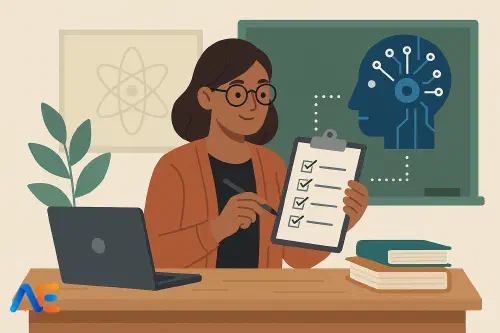
To make this easy to act on, turn these ideas into a one‑page checklist you can keep in your planner or on your desktop. Include:
- Your one priority pain point for Term 2
- The 6–8 habits you are trialling, with specific days/times
- The “stop if…” rule for each habit
- A half‑term review date, with the Keep/Tweak/Drop decisions
You can also adapt this into a simple departmental template so colleagues can share what they are trying, without pressure to adopt identical practices.
With clear boundaries, tiny time‑boxed experiments, and a planned exit strategy, AI resolutions stop being vague hopes and start becoming sustainable classroom habits that either earn their place – or gracefully bow out.
Happy habit-building!
The Automated Education Team