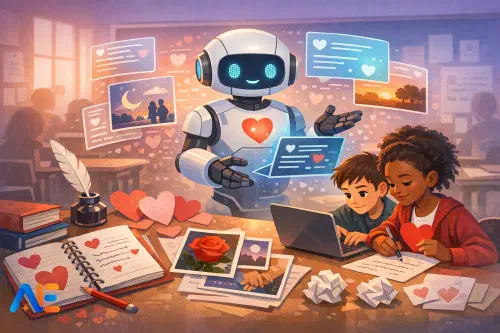
Valentine’s poetry is often treated as a quick seasonal activity: write something sweet, add a heart, move on. Yet it can be one of the most efficient ways to teach what matters in writing: deliberate choices. When pupils shape tone, select images, control rhythm, and decide where to break a line, they are practising judgement. AI can support that judgement—if it is framed as a constrained co-writer, not a replacement author.
This “poetry studio” approach is designed to make the human work visible. Pupils still generate meaning. AI helps by offering options inside strict boundaries, so you can assess the decisions pupils make, not the fluency of a tool. If you want a wider framing on when AI supports learning (and when it undermines it), see When AI Helps vs Harms Learning.
Learning goals
The non-negotiables are voice, choice, and process evidence. Voice means pupils can explain what they are trying to make the reader feel, and how their language choices create that effect. Choice means pupils select from possibilities—words, metaphors, structures—and justify why one option is better than another. Process evidence means you can see the journey: oral rehearsal notes, an imagery bank, AI outputs kept as “materials”, and redrafts that show purposeful change.
In practice, this looks like pupils saying, “I chose bruise-blue instead of sad because it feels more specific,” or “I moved the line break to make the pause sharper.” Those comments are assessable, and they are the opposite of passive copying. It also aligns with future-facing skills that remain distinctly human: taste, judgement, empathy, and interpretation. For more on that bigger picture, link your department discussion to Future-proofing Students’ Skills AI Can’t Replace.
Set-up in 10 minutes
Start with a safe tool choice and an explicit pupil agreement. You do not need the “most powerful” model; you need a predictable one with clear school controls. Whatever you use, establish a simple rule: no personal data, no real names, no identifying details. For Valentine’s work, make it even tighter with a “fictional Valentine” rule: poems are addressed to an invented person, an object, a place, or an abstract idea (like “Courage” or “Winter Sun”). This removes pressure and reduces the risk of awkward disclosures or targeted comments.
Put the agreement in pupil-friendly language: AI can suggest options, but pupils must choose, edit, and explain. If you are building this into your digital citizenship curriculum, connect it to Digital Citizenship and AI so expectations are consistent across subjects.
Finally, decide how you will capture process evidence. A simple approach is a “studio sheet” with three boxes: (1) my intention (tone and audience), (2) my materials (word bank, images, AI suggestions), (3) my decisions (what I kept, changed, and why). If you want a drafting workflow that keeps versions tidy, adapt ideas from the OpenAI Canvas Drafting Guide.
KS1 poems
With younger pupils, keep the goal narrow: sound and feeling. Begin orally. Give a shared stimulus (a paper heart, a soft toy, a picture of a winter sky) and ask for feeling words, then sound words. Build a class word bank with colour, texture, and movement: “flutter”, “warm”, “sparkle”, “gentle”, “thump”.
Here, AI acts only as a vocabulary suggester, and only after pupils have started the bank themselves. You might ask the tool for ten child-friendly words that match a feeling you have already named, then pupils circle the ones that “sound right”. The poem structure can be repetition-based: “I love… / I love… / I love…” or a simple chant with a refrain. Because performance matters at KS1, rehearse the poem aloud before writing, and let pupils decide where to pause. The assessment focus is not “advanced vocabulary”; it is whether the poem creates a feeling through repetition and sound.
KS2 poems
At KS2, shift to metaphor and simile, but keep the process tactile. Use “ingredient cards”: short prompts pupils can combine, such as “Love is like…”, “Your laugh is…”, “My heart is…”, plus image nouns (lantern, magnet, compass, thunder, blanket) and sensory verbs (glows, tugs, crackles, wraps).
AI can generate additional ingredient cards, but pupils must act as selectors and editors. The teacher move is to model rejecting ideas. When the AI offers “love is like a rose”, you can say, “That’s common. Can we make it ours?” Pupils then choose one idea and make it specific: “Love is like a torch in a power cut,” or “Your kindness is a blanket on a loud day.” Encourage them to add one concrete detail that only they could choose, drawn from classroom life, hobbies, or shared texts—without naming real people.
KS3 poems
KS3 is ideal for form play. Pupils can draft three short versions of the same Valentine message: an acrostic, a cinquain, and a free verse fragment. AI is useful here as a constraint engine and a line-level alternative generator. For example, pupils decide the message first (“admiration without romance”, “friendship”, “self-respect”), then ask AI for form rules, not finished poems.
A productive routine is “one line, three options”. Pupils write a line, then ask AI for three alternative phrasings that keep the same meaning but change rhythm or imagery. Pupils choose one, then explain their choice: “I kept the shorter line because it hits harder,” or “I chose the version with internal rhyme because it feels playful.” This keeps authorship with the pupil while making craft decisions explicit.
KS4 poems
At KS4, the focus can move to imagery, tone, and subtext. Pupils often need support to avoid cliché and to tighten language without flattening voice. Use AI as a critique partner rather than a generator. Pupils provide a draft and ask targeted questions: “Which phrases sound clichéd?” “Where is my tone unclear?” “Which line is doing the least work?” The key is that the AI must point, not replace.
Teach pupils to treat critique as a hypothesis. If the AI flags a phrase as vague, pupils must decide whether to sharpen it, keep it for effect, or replace it with a more precise image. Encourage “tightening passes”: one pass for removing filler words, one for strengthening verbs, one for line breaks and pauses. When pupils read the poem aloud, they should hear the difference after each pass.
Discover the power of Automated Education by joining out community of educators who are reclaiming their time whilst enriching their classrooms. With our intuitive platform, you can automate administrative tasks, personalise student learning, and engage with your class like never before.
Don’t let administrative tasks overshadow your passion for teaching. Sign up today and transform your educational environment with Automated Education.
🎓 Register for FREE!
KS5 poems
With KS5, you can tackle the sophisticated tension between voice imitation and voice development. This is where ethical modelling matters. If pupils study a poet’s style, position AI as a tool for analysing features (syntax, imagery patterns, typical line length), not for producing a counterfeit poem “by” that writer. Pupils can ask AI to describe the moves of a poet, then write an original piece that borrows one move deliberately—perhaps a pattern of enjambment, or a recurring semantic field—while keeping content and voice their own.
The most powerful KS5 addition is commentary writing. Pupils write a short reflective paragraph explaining their intertextual choices: what they borrowed, what they resisted, and why. This makes voice development assessable and reduces the temptation to submit AI-generated work, because the commentary requires genuine insight into process.
Redrafting routines
To prove authorship, build redrafting into the studio as evidence, not as punishment. Use decision logs: pupils record three changes they made and the reason for each, referencing tone, rhythm, clarity, or imagery. Add before-and-after snapshots: one stanza kept as an “original draft photo” (even if typed), followed by the revised version with changes highlighted.
Read-aloud checks are non-negotiable. Pupils read to a partner, who marks where they naturally pause and where meaning blurs. Then pupils decide whether to change punctuation or line breaks. This is an excellent moment to show that line breaks are meaning, not decoration.
Assessment and feedback
Keep rubrics simple and craft-focused. You are not grading “how romantic” a poem is; you are grading choices. A useful rubric can cover: intentional tone (clear and consistent), crafted imagery (specific and fresh), control of sound and rhythm (repetition, alliteration, pace), and structure (line breaks or form used with purpose). Add “originality by design”: pupils must show at least two deliberate departures from common Valentine clichés, explained in their decision log.
Finally, include an AI-use reflection: a short statement of how AI was used (vocabulary, constraints, critique), what was rejected, and what the pupil changed. This normalises transparent practice and gives you a fair basis for feedback.
Prompt frames
Use tight frames that force pupil decisions. Teacher prompts should constrain the tool; pupil prompts should constrain the writing.
A teacher prompt might be: “Suggest ten concrete, child-friendly words linked to the feeling ‘proud’ (no love/heart/rose words). Include verbs and adjectives.” Or: “List five alternative line breaks for this two-line sentence, keeping words the same. Explain the effect of each break.”
A pupil prompt might be: “Here is my stanza. Identify one cliché and offer three more specific replacements. Keep my tone: quiet, not gushy.” Or: “Give me three ways to rephrase this line with the same meaning: one shorter, one with internal rhyme, and one with a surprising image.”
For low-device or offline variants, keep the studio structure and swap AI for human “option generators”. One group becomes the “vocabulary desk” with thesauruses and mini word banks. Another becomes the “constraint desk” that hands out form rules on cards. A third becomes the “critique desk” using a checklist for cliché, vagueness, and rhythm. The key is the same: pupils gather materials, then choose.
May your classroom be full of brave metaphors and purposeful line breaks!
The Automated Education Team