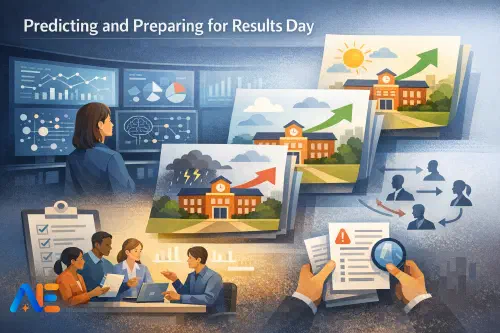
Why a war room
Results day rarely fails because people don’t care. It fails because too many decisions land at once: anxious students, limited rooms, phone lines, appeals windows, and staff who are trying to be both calm and fast. A “war room” approach treats results day like an operational event with pre-agreed scenarios, clear ownership, and rehearsed communications. AI can help you prepare those scenarios quickly, but only if you keep it firmly within a governed process and avoid letting it become an unchallengeable judge.
If you already use AI for operational planning in other contexts, you’ll recognise the pattern: define outputs, define checks, then automate the boring parts. The same logic appears in building AI workflows that stick, and it matters even more when the stakes are personal and time-sensitive.
What preparation needs
Results-day preparation needs three things: an honest forecast, a practical plan, and a safe decision chain. The forecast is not a single number; it is a range of plausible grade distributions that you can plan around. The practical plan translates those distributions into staffing, spaces, timetables, scripts, and escalation routes. The safe decision chain makes sure no automated output becomes an action without a human checking context, evidence, and fairness.
What AI should not do is quietly decide who is “at risk”, who gets contacted first, or whether an appeal is “worth it”. Those are professional judgements with ethical and emotional weight. AI can summarise evidence, draft options, and highlight inconsistencies, but it must not be the final voice. If you want a simple boundary language for staff, adapt the traffic-light approach in exam-season AI boundaries so everyone knows what is allowed, what needs approval, and what is off-limits.
Data you can use safely
A minimum viable dataset is usually enough to build useful scenarios without pulling in highly sensitive detail. Aim for aggregated historic grade distributions by subject/course, prior attainment bands (again aggregated), cohort size, and known operational constraints such as available staff, rooms, and key timings. If you have reliable historic patterns for grade movement by subject, include those as ranges rather than precise predictions.
Anonymisation is not just removing names. Small cohorts can be re-identifiable, especially in niche subjects. Use thresholding (for example, do not report subgroup breakdowns below an agreed minimum) and keep the scenario modelling at cohort or class level, not individual level. Access controls should be explicit: who can view raw data, who can view scenario outputs, and who can export anything. If you are using an AI tool, ensure it is configured so data is not used to train public models, and keep a record of where data went and why.
For many schools, the biggest risk is not malicious use; it’s “helpful” over-sharing when pressure rises. A short permission model and a shared checklist, reviewed before exam season, reduces that risk. If you’re building a wider evidence trail, the structure in end-of-year AI audit evidence pack translates well to results-day governance.
From attainment to scenarios
Your goal is three scenario plans: best, expected, and worst. Think in distributions, not individual outcomes. Start with last year’s grade distribution per subject/course and compare it with the last two to three years, if available. Then layer in cohort differences you can justify: changes in entry numbers, prior attainment band mix, staffing stability, or curriculum changes. Keep these adjustments as small, explainable shifts with a reason attached, rather than letting a model “discover” patterns you cannot defend.
AI can help by generating a first-pass set of distributions and turning them into tables you can discuss. For example, you might ask it to propose a plausible expected distribution given historic ranges, then generate best and worst by applying agreed “stress tests”, such as a one-grade downward shift for a percentage of borderline entries in a subject that historically fluctuates. The key is that the stress tests are yours, documented in plain language, and applied consistently.
When you present scenarios to colleagues, show the assumptions alongside the numbers. If someone cannot explain a scenario in two sentences, it is too complex for results day.
A small indicator set
Avoid black-box “risk scores”. Instead, define a small indicator set that flags where human attention might be needed. Keep it explainable and auditable. For example, you might use indicators such as: an unusually large year-on-year distribution change in a subject; a high proportion of borderline grades compared with historic norms; a subject with known operational pressure (high volume, limited specialist staff); or a mismatch between internal assessment patterns and historic outcomes that warrants a careful look.
Each indicator should have a threshold, a rationale, and an owner. AI can calculate and surface the indicators, but it should not decide what they mean. A good test is whether a middle leader can challenge an indicator without needing a data scientist in the room.
If you are tempted to move from indicators into individual-level lists, pause and review the cautions in mis-integrated AI analytics. Results day is the worst time to discover that a “smart” list quietly bakes in bias or errors.
Operational planning outputs
Once scenarios exist, convert them into operational outputs that reduce friction on the day. Under the worst-case scenario, what is the maximum number of students likely to need a conversation about next steps? Under the best-case scenario, where do you still expect pressure (for example, popular pathways with limited places)? Translate those into staffing rosters, room plans, queue management, and a timetable for who is available when.
AI is particularly useful for drafting versions of call scripts and email templates that match each scenario, then tailoring them to your tone. It can also help generate a simple escalation map: who handles urgent safeguarding concerns, who confirms pathway offers, who triages appeals queries, and who manages data corrections. Treat these as runbooks: short, practical documents that someone can follow when tired.
If you’ve ever run a large school event with a sign-off chain, you can borrow the same discipline here. The approach in AI event ops workflows maps neatly onto results day: clear roles, pre-written messages, and a single source of truth.
Discover the power of Automated Education by joining out community of educators who are reclaiming their time whilst enriching their classrooms. With our intuitive platform, you can automate administrative tasks, personalise student learning, and engage with your class like never before.
Don’t let administrative tasks overshadow your passion for teaching. Sign up today and transform your educational environment with Automated Education.
🎓 Register for FREE!
Intervention planning
Intervention planning should happen before results day, but interventions must not be triggered automatically. Build a draft contact plan for each scenario: who might need a call, who gets an invitation to a meeting, and which staff member is best placed to speak with them. Then add mandatory human checks before anything is sent.
A practical pattern is a two-step list. Step one is an AI-assisted “candidate list” built from your indicator set and known constraints (for example, students needing a pathway decision quickly). Step two is a human-reviewed “action list” where leaders confirm context: recent circumstances, support already in place, student preferences, and any safeguarding considerations. The action list should record who approved it and when. On the day, staff then work from the approved list, not the candidate list.
This is also where workload can spiral. Keep contact attempts realistic. A smaller number of well-timed, well-informed conversations is better than a frantic attempt to reach everyone at once.
Appeals and reviews
Appeals and reviews need calm triage rules, not improvised debate. Define categories of query (data error, procedural concern, judgement concern, information request) and attach a simple evidence checklist to each. AI can help by producing a documentation workflow: what gets logged, where files are stored, what metadata is required, and what the next step is. It can also draft parent- and student-facing explanations that are accurate and empathetic, provided a human checks them before sending.
Be wary of AI that “recommends” whether to appeal. Instead, have it summarise relevant evidence you already hold and map it to your published criteria. If you need to stay aligned with changing guidance, keep an eye on policy updates through something like AI policy watch, and translate any changes into your local runbook before results day.
Governance and sign-off
Governance is what turns “we used AI” into “we used AI responsibly”. Start with DPIA-style prompts: what data is processed, for what purpose, with what lawful basis, where it is stored, and who has access. Add fairness checks: do your indicators disproportionately flag particular groups, subjects, or pathways without a clear educational reason? Then add logging: what prompts were used, what outputs were generated, who reviewed them, and what decision was taken.
Retention matters too. Results day produces sensitive notes and messages. Set a retention period for drafts, candidate lists, and logs, and make deletion someone’s job, not a vague intention.
Finally, make the human sign-off chain non-negotiable. Any risk flag, intervention action list, or appeal recommendation should require named approval, ideally with a second checker for high-impact decisions. If you’re improving your wider school process maturity, a structured reflection cycle like the term 2 after-action review framework helps you keep governance alive rather than seasonal.
Templates to prepare
You don’t need a huge pack, but you do need consistent templates that reduce cognitive load under pressure. Prepare prompt frames that constrain AI to your dataset and your rules, a scenario table that shows assumptions and distributions, a results-day run sheet with timings and owners, a comms pack with scenario-specific messages, and a sign-off form that captures approvals and rationale.
Keep templates short and stored in one shared location with controlled access. On results day, the best template is the one people can find in ten seconds.
After results day
Book a 60-minute debrief within a week while memories are fresh. Use it to compare scenarios with reality, identify bottlenecks, and capture script improvements. Ask staff where they felt uncertain, and whether the sign-off chain helped or slowed them. Then update your indicators and thresholds for next year, and tighten any access controls that proved leaky in practice.
Most importantly, decide what you will stop doing. A war room is not about more paperwork; it is about fewer surprises.
May your results day feel calm, clear and well-supported.
The Automated Education Team