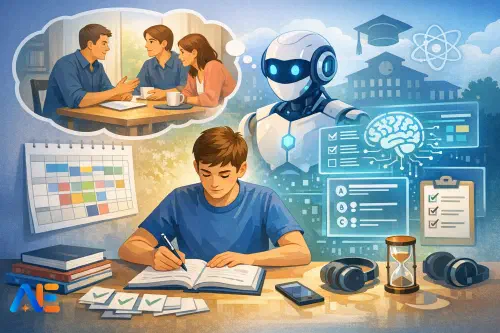
What mock season needs
Mock season needs operational reliability more than novelty. Students need a clear plan they can follow on tired evenings, practice that actually strengthens memory, and feedback loops that catch misconceptions early. Teachers need consistency across classes, without creating a marking avalanche. Families need clarity about what “help” looks like at home, especially when AI tools are a tap away.
What mock season does not need is AI as a private tutor or answer machine. If students can prompt their way to model paragraphs, full solutions, or “perfect” analyses, you will see inflated homework confidence and fragile exam performance. A useful framing is to treat AI as a revision operations assistant: it organises routines, generates practice from approved content, and helps spot patterns in errors. It does not produce assessed answers. If you want a ready-made way to communicate these boundaries, see Exam-season AI boundaries, which includes simple scripts you can reuse with classes.
Set the boundaries
A mock-season AI integrity agreement is most effective when it is short, specific, and shared with families. Students should know what they are allowed to do, what they are not allowed to do, and what to do when they are unsure. Families should know what “support” means in practice, and why certain AI uses undermine learning.
In prose, the agreement can sound like this: AI may help you plan, quiz, and reflect, but it must not write your answers or tell you what to write. You may use AI to turn your teacher’s notes into self-quizzing prompts, but you may not paste exam questions and ask for a full response. You may use AI to explain a mark scheme after you have attempted a question, but you may not use it to generate a first attempt. You will keep your prompts general and avoid sharing personal data.
If your school already has an AI acceptable use policy, mock season is a good moment to refresh it with a one-page addendum. The AI acceptable use refresh checklist is a helpful structure for aligning staff language and expectations, so students do not hear mixed messages.
The best revision timetable is not the most detailed one. It is the one students can follow for three weeks without collapsing. Start with protected non-negotiables: sleep, meals, travel, and any caring or work responsibilities. Then add “protected rest” blocks, because burnout is not a badge of effort; it is a predictor of poor recall and low-quality practice.
A simple model is to build in short daily sessions and two longer weekend blocks. For example, a Year 11 student might manage two 25-minute retrieval sessions on weekdays, plus one 60–90 minute timed practice session on Saturday. The timetable should include catch-up space, because life happens. If you remove all slack, students either give up or start lying about progress.
AI can help generate a realistic timetable, but only if the inputs are sensible. Ask students to list their subjects, their mock dates, and their weekly commitments, then have AI propose a plan with built-in rest and catch-up. The teacher’s role is to sanity-check: are there too many heavy subjects in one evening? Is the plan ignoring travel time? Is it pretending motivation is infinite? For a stronger “short cycles” approach that avoids overplanning, you may also like AI catch-up micro-cycles, which adapts well to mock season.
Retrieval practice at scale
Retrieval practice is where AI can genuinely help, provided you control the source material. The key rule is teacher-approved content only. That might be a knowledge organiser, a set of lesson slides, a revision booklet, or a department glossary. Students (or teachers) can paste small sections and ask AI to generate daily mini-sets: short questions, flashcard prompts, cloze sentences, and “spot the misconception” statements.
In a practical classroom example, a science teacher might provide a one-page summary of required practicals. Students then use AI to generate ten quick questions each day, mixing definitions (“What is a control variable?”), process recall (“List the steps for titration”), and application (“Which variable would you change to test…?”). The student answers without AI, then checks against the teacher material. The AI’s role is to vary prompts and spacing, not to provide the answer path.
To keep this integrity-safe, build a default prompt that forces the right behaviour: “Only use the text I provide. Do not add extra facts. Ask me questions; do not answer them unless I ask for marking guidance after I attempt them.” If you want a fuller system that combines retrieval, error logs, and timed practice, the 28-day exam sprint model offers a coherent sequence you can compress into the mock window.
Discover the power of Automated Education by joining out community of educators who are reclaiming their time whilst enriching their classrooms. With our intuitive platform, you can automate administrative tasks, personalise student learning, and engage with your class like never before.
Don’t let administrative tasks overshadow your passion for teaching. Sign up today and transform your educational environment with Automated Education.
🎓 Register for FREE!
Error logs and misconception loops
Mocks are not just a score; they are a dataset about misconceptions. The challenge is turning that into action without drowning in re-teaching. An “error log” routine helps: students record the topic, the question type, what they wrote, what the mark scheme wanted, and the likely reason for the miss (didn’t know it, misread it, ran out of time, misunderstood command words).
AI can support this without rewriting answers. Students can paste their own attempted response and the mark scheme (or teacher feedback) and ask AI to classify the error and propose a next step, such as “create three retrieval questions on X” or “practise two ‘explain’ questions using this sentence stem”. The boundary is crucial: the AI must not produce a polished replacement paragraph. It can help name the misconception and suggest practice, but the student must do the thinking and rewriting.
In English literature, for instance, a student might consistently drift into plot summary. AI can help spot that pattern across several attempts and suggest a routine: highlight one quotation, write one analytical sentence using “This suggests…”, then link to context in one line. The student still writes the sentences; AI simply flags the habit and prompts a better structure.
Timed practice and technique
Timed practice is where students often avoid discomfort, even when they have revised content. AI can help with “before and after” coaching only. Before: it can generate a checklist for the paper (timings, common command words, what to do if stuck). After: it can help students compare their attempt with a mark scheme and identify which marks were missed and why.
During the timed task, AI should be off-limits. That includes “just checking” a paragraph midway through. If students practise with constant hints, they train dependence, not recall. You can make this explicit in your integrity agreement and reinforce it with a simple routine: devices away, timer visible, and a short debrief afterwards. The debrief is where AI can help students reflect efficiently: “Which question cost you the most time? What was your first wrong turn? What will you do differently next time?”
Safeguarding and privacy
Mock season increases the temptation to paste too much into tools: personal details, wellbeing disclosures, or identifiable work. Set minimum-data rules and repeat them often. Students should not paste full class lists, personal circumstances, or anything that would be inappropriate on a public noticeboard. If students are using AI at home, include a redaction habit: remove names, school identifiers, and any sensitive context before sharing text.
A practical “never paste” list helps because it is concrete: full exam papers that are not publicly released, student names and contact details, medical or safeguarding information, and anything from a protected platform. If you want to align this with wider school practice, the minimum-viable AI toolkit on privacy defaults provides a sensible baseline that departments can adopt without becoming policy experts. For wellbeing boundaries, especially when students are stressed, the wellbeing copilot safeguarding guide is a useful companion.
Parent and carer comms
Families often want to help but default to pressure, extra tutoring spend, or unstructured “revise more”. A simple comms pack can reduce friction. A weekly update template works well: what we are focusing on this week, what a good revision session looks like, and what to do if your child is stuck. Keep it short, and avoid jargon. If you already run parent consultations, you can adapt the tone and structure from the one-page parent conversation brief.
Include an FAQ that answers the awkward questions plainly: “Should my child use AI?” “How do we stop cheating?” “What if they are anxious?” “What should I do when they ask for help?” The most helpful guidance at home is often behavioural rather than academic: a quiet space, a visible timer, a short break routine, and encouragement to attempt first. If parents want to check work, steer them towards asking students to explain their thinking aloud, which reveals gaps without supplying answers.
Department rollout
A two-week implementation plan keeps this manageable. In week one, agree boundaries and provide the teacher-approved content pack for each subject: the pages students are allowed to use for AI-generated retrieval. Set the default prompts, introduce the error log template, and run one timed practice routine in class so students experience the “AI off during, AI on after” rule.
In week two, standardise the check-in loop. Students submit a short weekly reflection: what they did, what went wrong, and the next three actions. Families receive the same short update so home support aligns with school expectations. Keep impact measures simple: completion rates for retrieval mini-sets, number of timed practices attempted, and the top three misconceptions per class. You are looking for behaviour change and earlier correction, not miraculous grade jumps in five days.
May your mock season feel calmer, fairer, and more focused on learning than last time.
The Automated Education Team