Why festive tasks miss the mark
Festive computing lessons often look lively but teach very little about AI. Pupils generate a snowman image, ask a chatbot for a winter poem, or produce a poster in seconds. The room feels busy, yet the learning can remain shallow. If we want December activities to be more than seasonal filler, pupils need to grapple with how systems classify, where they fail, and how we judge whether an output is actually any good.
A better route is to use the festive theme as the context, not the objective. Seasonal cards, winter scenes and holiday adverts give pupils familiar material to analyse, sort and test. That keeps motivation high while protecting disciplinary thinking. This approach works especially well if you already favour paper-first routines, as explored in autumn-term harvest activities, where the emphasis stays on evidence rather than spectacle.
What pupils should learn
Before launching into the projects, it helps to name the ideas clearly. Pupils do not need advanced mathematics to understand a classifier. They need to know that a classifier sorts examples into groups using chosen features. In a festive context, those features might include colour, shape, text, objects present, or even tone.
Training data is the set of examples used to build or refine the rule. Test data is the fresh set used afterwards to see whether the rule actually works. Evaluation is the process of checking performance rather than assuming success because a few examples looked right. That distinction matters. Many pupils think an AI system is “good” if it gets one obvious example correct. We want them to ask harder questions: how often is it right? What kinds of examples confuse it? Who might be disadvantaged by the mistakes?
These ideas connect naturally to wider classroom conversations about fairness and representation. If you want to extend that strand, AI ethics classroom routines and representation audits provide useful follow-on structures.
Project 1: Paper classifier
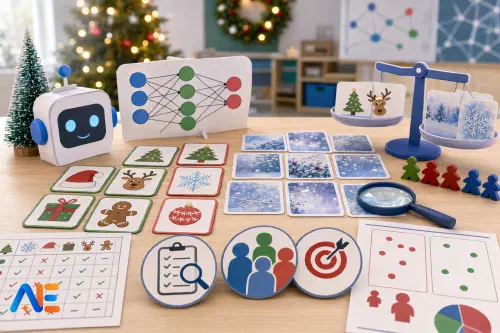
The first project is simple, tactile and surprisingly rigorous. Give pupils a set of festive sorting cards. These might show wrapped gifts, candles, stars, snow scenes, greeting cards, lights, winter clothing and non-festive distractors such as umbrellas or beach balls. Ask pairs to create a rule-based classifier for a category such as “festive” versus “not festive” or “winter scene” versus “celebration scene”.
The key is that they must state the features their classifier uses. A pupil might begin with, “If it has snow, it is winter.” Another group may choose, “If it contains lights or a tree, it is festive.” Very quickly, edge cases appear. A streetlight in fog is not a festive light display. A starfish is not a holiday star. A red scarf could suggest winter, but not necessarily celebration.
Once pupils have drafted their rules, give them a separate test set. This is where the learning sharpens. They discover that broad rules catch too much, while narrow rules miss valid examples. Encourage them to record false positives and false negatives, even if you do not use those formal terms with younger classes. They are learning that classification is about trade-offs, not magic.
This project also supports excellent talk. One pupil can defend a rule, while another challenges it with a counter-example. The discussion often becomes more thoughtful than a screen-based task because everyone can see the data in front of them.
Project 2: Winter image mistakes
Image recognition feels more exciting to many pupils, but it can stay grounded if you frame it as an investigation into failure. Show a sequence of winter images and ask pupils to predict what a model might struggle with. Scenes with low light, heavy snow, reflective surfaces, bundled-up figures and unusual camera angles are ideal.
You do not need expensive tools. A teacher-curated slide deck is enough. Pupils can compare clear examples with ambiguous ones and annotate possible reasons for confusion. A snowy football pitch may hide the lines. A reindeer decoration may be mistaken for a real animal. A person in a thick coat and scarf may obscure key facial or body features. If an image is mostly white, contrast drops and detail disappears.
What matters is that pupils explain why recognition fails. They begin to see that a model is only as robust as the data and features available to it. This connects nicely to misconceptions pupils often hold about AI “seeing” like humans. If you want another example of using themed content to challenge weak assumptions, Bonfire Night forensics offers a similar pattern.
You can deepen the task by asking pupils to sort images into “likely easy”, “likely difficult” and “likely misleading” before discussing outcomes. That prediction stage gives you useful assessment evidence and keeps the focus on reasoning.
Project 3: Card design tests
A festive greeting card project brings in a marketing crossover without becoming superficial. Pupils create two versions of a card front for the same audience, perhaps younger pupils, families or school staff. Version A might use bright colours and a playful illustration. Version B might use a simpler layout and a stronger headline. The question is not which one pupils personally prefer. The question is which one performs better against a chosen goal.
That is the opening for A/B testing. Explain that both designs are tested with a comparable audience, and the result is judged using evidence. In class, this could be a quick survey on which card is clearer, warmer, more memorable or more likely to be chosen from a display. Pupils must define the success measure first. Otherwise, they are only collecting opinions.
This is a powerful introduction to evaluation and optimisation. Pupils see that changing one feature at a time makes the comparison fairer. They also learn that “best” depends on the metric. The card with the boldest title may be easiest to read, while the illustrated version may feel friendlier. That distinction mirrors real AI evaluation: systems can perform well on one measure and poorly on another.
Discover the power of Automated Education by joining out community of educators who are reclaiming their time whilst enriching their classrooms. With our intuitive platform, you can automate administrative tasks, personalise student learning, and engage with your class like never before.
Don’t let administrative tasks overshadow your passion for teaching. Sign up today and transform your educational environment with Automated Education.
🎓 Register for FREE!
If you are working with classes who enjoy speaking their ideas aloud before writing, you can pair this with structured verbal justification, much like the routines discussed in voice AI and formative assessment.
Bias and edge cases
One of the best things about these projects is that bias appears naturally. If all the “festive” cards show snow, pupils may start linking celebration with cold weather. If winter images show only one type of home, clothing or tradition, pupils may infer that these are the norm. If greeting card tests use only one audience group, the findings may not generalise.
You do not need to overcomplicate this. Ask simple questions. What examples are missing? Which rule worked for most cases but failed badly for a few? Which design choice helped one group but not another? These prompts make bias concrete.
False positives are also easy to surface. A holly-green jumper may be labelled festive when it is simply green. A snowy car park may be tagged as a winter “nature” image. A card with glitter may attract attention but communicate very little. Pupils begin to understand that errors are not random annoyances; they reveal something about the underlying rule or dataset.
Assessment that fits
Assessment can stay light and still be meaningful in the final weeks of term. Exit tickets work well if they ask pupils to define a classifier in their own words, name one feature they used, and explain one mistake their system made. Prediction tables are equally useful. Before testing, pupils record which examples they think will be easy or difficult and why. Afterwards, they compare prediction with outcome.
Error analysis is especially strong here. Ask pupils to choose one wrong result and explain the cause. Was the rule too broad? Was the image unclear? Was the success measure poorly chosen? These explanations reveal much more than a polished final product.
For classes that need structure, sentence stems help: “Our classifier used ___ as a feature”; “It failed when ___ because ___”; “A fairer test would include ___.” If you are planning end-of-term routines across several subjects, December countdown planning offers a helpful wider framework.
Adapt for your setting
These tasks are flexible across phases. In primary classrooms, keep the language simple and use physical cards, large images and whole-class voting. Pupils can sort, predict and justify orally. In secondary settings, introduce terms such as training data, test data, false positive and optimisation, then ask for short written evaluations.
For mixed-access classrooms, the paper-first design is a strength. One table can classify printed cards while another analyses projected images. If devices are available, they can be used for recording results rather than driving the whole lesson. That reduces technical friction and keeps the concept at the centre.
Display work can also stay disciplined. Instead of showcasing only the prettiest card designs, include “rules that failed”, “hard cases” and “how we improved our test”. This approach aligns well with inclusive classroom displays, where the display supports retrieval and explanation rather than decoration alone.
A one-week sequence
A simple December sequence can run over five short lessons. Start with key vocabulary and a quick sorting challenge. Move next to building and testing paper classifiers. Then investigate winter image recognition failures. Follow with greeting card A/B testing and evaluation. Finish with reflection, error analysis and a display or mini-showcase built around evidence.
That sequence feels festive without drifting into fluff. Pupils make predictions, test ideas, revise rules and justify conclusions. In other words, they do the real intellectual work behind AI, just with tinsel-friendly materials.
When festive projects teach pupils how classification, bias and evaluation actually work, the season stops being a distraction and becomes a memorable context for serious learning.
May your final-week lessons be calm, curious and full of good evidence.
The Automated Education Team