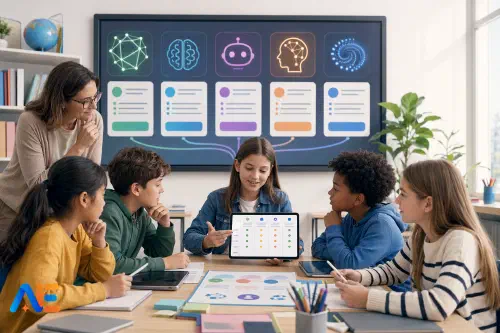
Perplexity AI Model Council offers teachers a useful shift in emphasis. Instead of asking pupils to pick a favourite tool, it allows them to compare responses from different models side by side and ask sharper questions about quality, trust and persuasion. At a time when AI outputs can sound equally polished, that matters far more than brand loyalty. If your school is already reviewing new tools, articles such as GPT-5 in schools and Claude’s recent school briefing can help staff build background knowledge, but the classroom goal should stay simple: teach pupils how to compare claims, not cheer for systems.
Why compare models
When pupils ask which model is “best”, they often mean which one sounds smartest, responds fastest or agrees with them most clearly. None of those measures is enough. In real classrooms, the better question is which answer uses evidence carefully, signals uncertainty honestly, avoids overclaiming and leaves fewer important gaps. A comparison lesson makes those features visible. It also helps pupils see that AI outputs are constructed responses, not neutral truth.
This approach fits naturally within wider AI literacy and media literacy work. If you have already used case studies or discussion routines from an AI ethics classroom kit, Model Council can act as the practical lab session that follows. Pupils move from abstract talk about bias and reliability to concrete examples on the page.
What Model Council changes
The most useful feature of Perplexity AI Model Council is not novelty. It is control. Pupils can inspect how GPT-5.2 and Claude 4.6 respond to the same task at the same moment, with the same wording. That removes one common classroom problem: pupils comparing outputs that came from different prompts and then drawing shaky conclusions.
This side-by-side view makes subtle differences easier to notice. One model may include more references but rely on weak or repetitive sources. Another may sound balanced but quietly omit a counterargument. A third may use highly persuasive phrasing that makes a thin answer feel strong. Because the prompt is held constant, pupils can focus on the response itself. That creates a much cleaner evaluation exercise than asking them to test tools separately at home.
Simple lesson setup
A successful lesson does not need technical language or long preparation. Start with one shared prompt, one clear task and one set of success criteria. For example, a history class might ask both models, “What were the main causes of the Industrial Revolution, and which cause mattered most?” A science class might ask, “Should cities invest more in solar or wind power?” An English class might ask, “How does the writer create sympathy for this character?”
Project both responses or provide printed copies. Ask pupils to annotate individually first. They should not begin by voting for a winner. Instead, they should underline evidence, circle hedging words, mark missing viewpoints and highlight emotionally persuasive phrasing. Then ask pairs to compare notes before any whole-class discussion.
A useful rule is that pupils must justify every judgement with something visible in the text. “This one sounds better” is too vague. “This one gives two examples, names a source and admits uncertainty in paragraph three” is much stronger. That habit mirrors the kind of careful checking we want in wider digital literacy.
Five things to compare
Evidence
Pupils should ask what counts as support in each answer. Does the model cite examples, refer to studies, mention dates or point to named sources? More evidence is not always better. Sometimes a response piles up references without explaining them. Sometimes one precise example is more useful than five vague claims. Encourage pupils to ask whether the evidence is relevant, specific and actually connected to the point being made.
Confidence
Many pupils assume confidence signals correctness. AI comparison lessons are a good place to challenge that idea. One model may sound decisive even when the topic is uncertain. Another may use careful phrases such as “likely”, “may” or “scholars disagree”. Pupils should learn that honest uncertainty is often a strength, not a flaw.
Bias
Bias can appear through what is emphasised, whose perspective is centred and which assumptions go unchallenged. In a geography task about development, for instance, one answer might frame progress only in economic terms while ignoring environmental or local community perspectives. In a literature task, one answer may treat one interpretation as obvious and overlook alternatives. This connects well with broader representation work, including activities such as a representation audit.
Omissions
Omissions are often the most revealing feature because they are easier to miss than errors. Ask pupils, “What would a careful human teacher expect to see here that is absent?” In a balanced argument, is there no counterpoint? In a science explanation, is there no mention of variables or limitations? In a historical answer, are key groups or events missing? This question often produces the richest discussion.
Tone
Tone shapes trust. A polished, calm response can feel more reliable than a clumsy one, even when both are equally weak. Pupils should notice when a model uses assertive wording, rhetorical flourishes or emotionally loaded phrases to persuade. This is where media literacy becomes very practical: the class learns to separate style from substance.
A pupil scorecard
You do not need a technical rubric. A simple scorecard can work across age groups if the language is clear. For each model, pupils can rate evidence, confidence, bias awareness, omissions and tone on a scale from 1 to 5, then write one sentence of justification for each category. The sentence matters more than the number.
You might frame the categories in pupil-friendly language: “How well does it back things up?”, “Does it sound too certain?”, “Whose view is missing?”, “What has it left out?” and “Is it trying to win me over with style?” This keeps the focus on reading critically rather than decoding AI jargon. Schools building early routines for safe AI use may want to connect this with tutor-time norms such as those in a safe AI charter for Year 7.
Prompt sets that work
The best prompts are ones where reasonable differences can emerge. Factual recall questions often produce very similar answers, so they are less useful for comparison. Better prompts involve explanation, judgement, interpretation or trade-offs.
Across subjects, try prompts like these. In history: “Which factor most influenced the outbreak of this conflict?” In science: “Which method is most effective for reducing plastic pollution, and what are the limits?” In English: “Which interpretation of this poem is more convincing?” In citizenship: “Should governments regulate social media algorithms more strictly?” In each case, pupils can compare not just what the models conclude, but how they reason.
Discover the power of Automated Education by joining out community of educators who are reclaiming their time whilst enriching their classrooms. With our intuitive platform, you can automate administrative tasks, personalise student learning, and engage with your class like never before.
Don’t let administrative tasks overshadow your passion for teaching. Sign up today and transform your educational environment with Automated Education.
🎓 Register for FREE!
Source checking
One of the most important lessons comes when both answers sound convincing. That is exactly the moment pupils need a checking routine. Ask them to identify one claim from each response that can be verified independently. Then send them to a trusted textbook, class notes or a reliable source list you provide. The aim is not endless fact-checking. It is to build the habit of testing strong-sounding claims against something external.
This teacher-guided routine matters especially in sensitive topics. If you are working with emotionally charged or historically complex material, a source-based workflow like the one outlined in teaching remembrance sensitively with AI can help keep the lesson grounded in care and evidence.
Discussion protocols
Comparison lessons work best when disagreement is structured. Ask pupils to begin with “I noticed…” before “I think…”. That keeps them anchored in the text. Then move to “What might explain this difference?” and “Which answer would be safer to rely on, and why?” These questions help pupils discuss uncertainty without treating one model as a hero and the other as a failure.
It is also worth naming persuasion directly. Ask, “Which answer would persuade a tired reader more quickly?” and then, “Does that make it better?” Pupils often realise that smooth wording can hide weak support. This is a powerful media literacy moment because it transfers beyond AI to websites, videos and opinion pieces.
Assessment ideas
Assessment can stay light. An exit ticket might ask pupils to complete three sentences: “The biggest difference I noticed was…”, “The answer I would trust more is… because…”, and “One thing both answers still needed was…”. A comparison grid can capture evidence from the lesson without becoming burdensome. Short reflective writing also works well: pupils explain how their judgement changed after source checking.
If your department is already reviewing evolving AI tools and practices, broader reflections from pieces like ChatGPT’s education impact review can support staff discussion about how these comparison habits fit into longer-term curriculum planning.
Safeguards and boundaries
Teacher-in-the-loop routines are essential. Choose the prompts yourself, provide the success criteria and decide when source checking is required. Avoid open-ended personal advice, mental health prompts or high-stakes safeguarding topics. Keep the activity focused on curriculum content and critical reading.
Age-appropriate boundaries matter too. Younger pupils benefit from shorter texts, fewer categories and more guided discussion. Older pupils can handle more ambiguity and can compare how models frame uncertainty or disagreement. Whatever the age group, remind pupils that AI outputs are not final authorities. They are texts to be evaluated.
This principle aligns with wider school policy thinking, including work on constitutional rules, safeguards and boundaries in pieces such as Anthropic’s AI constitution for schools. The classroom message is consistent: use AI as material for judgement, not a shortcut around it.
Perplexity AI Model Council is most valuable when it helps pupils slow down. Side-by-side comparison turns flashy AI performance into something inspectable. Pupils learn to ask who is being cited, what is being omitted, how certainty is being signalled and why one answer feels more persuasive than another. That is not tool fandom. It is media literacy in action.
May your next comparison lesson spark sharper questions and stronger judgement.
The Automated Education Team