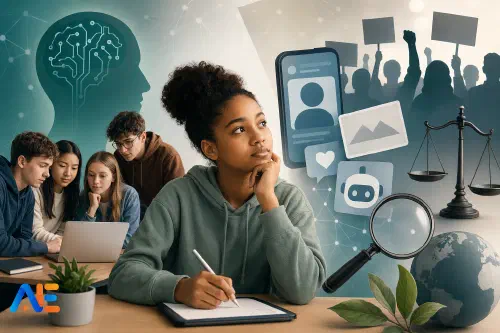
The QuitGPT movement is useful in school not because teachers need to endorse or dismiss it, but because it captures several live issues at once. Pupils can see how online campaigns spread, how claims about companies become moral arguments, and how digital tools become woven into daily life so quickly that leaving them feels difficult. In that sense, QuitGPT is less a niche internet story and more a rich classroom case study in consumer activism. It sits alongside wider questions about trust, dependency and governance that many schools are already discussing when they explore AI use more broadly, including in pieces such as ChatGPT adverts and free access.
Why it matters
A strong lesson on QuitGPT does not ask, “Which side is right?” Instead, it asks, “What is being claimed, by whom, with what evidence, and to what effect?” That shift matters. It moves discussion away from partisan performance and towards careful enquiry. Pupils can examine whether boycott calls are symbolic, practical or persuasive. They can explore how corporate political ties are framed online, and why some users treat association as sufficient reason to leave a platform while others demand direct evidence of harm.
This is also a useful moment to teach that digital citizenship includes economic choices. Young people are already used to seeing calls to stop buying from brands, stop using apps or stop supporting creators. AI platforms simply add a new layer because they are not just products; they are tools for writing, searching, coding and studying. If a platform becomes embedded in work routines, quitting it is no longer a simple moral gesture.
What pupils see online
What pupils are actually seeing online is often a messy mixture of boycott posts, cropped screenshots, reposted claims and emotional commentary. One post may allege a political donation or executive connection. Another may claim a company is censoring certain views. A third may insist that switching tools is easy and morally necessary. Very few of these posts arrive with full context.
That makes the case educationally valuable. A screenshot is not the same as a source. A trending claim is not the same as a verified fact. A boycott hashtag is not proof of a meaningful consumer movement. Pupils need practice in separating primary evidence from reaction, and reaction from rumour. If you have already taught comparison work using different AI outputs, perhaps through a lesson inspired by this classroom comparison lab, QuitGPT gives you a social and political extension of the same core literacy: compare, verify, contextualise.
From outrage to enquiry
The simplest way to keep discussion evidence-led is to give pupils a sequence of questions that slows them down. When a claim appears, ask what the original source is. Ask whether the source is direct, indirect or anonymous. Ask what exactly is being alleged: a donation, a partnership, a public statement, a hiring choice, a policy decision or an inferred political alignment. Ask what evidence would confirm or weaken the claim.
Then ask a second layer of questions about scale and significance. Even if a claim is true, what does it show? Does one executive’s action represent the company? Does one investor determine product decisions? Is there evidence that political ties changed the tool itself, its outputs or its moderation? Pupils often need help seeing that truth and relevance are not identical. A detail can be accurate but overstated.
Ethics without partisanship
Corporate ethics can be discussed safely when the frame stays focused on decision-making rather than party loyalty. Teachers do not need to invite students to defend politicians. They can ask how consumers evaluate organisations. What kinds of ties matter to users? Financial ties, lobbying, public endorsements, labour practices, environmental impact, data use and content moderation may all matter, but not equally to everyone.
This approach works well because it treats ethics as a matter of criteria. You might ask pupils to rank which kinds of corporate behaviour would most affect their trust in a platform. One pupil may care most about privacy. Another may care about political funding. Another may care about bias in outputs. The discussion becomes one about values, thresholds and evidence, not about winning a party-political argument. Teachers looking for wider governance context may find useful parallels in this piece on AI procurement and governance.
Boycotts and choice
Consumer activism is often presented online as clean and simple: if you disagree, leave. In practice, individual choice is constrained. Some pupils will quickly notice that quitting a platform is easier if you have time, alternatives and confidence in using other tools. Others may point out that many people use one AI service because their school, workplace or friendship group already does. That is a valuable insight. Boycotts are shaped by power, convenience and dependency.
This is where the QuitGPT case becomes more than a social media trend. It raises the question of whether consumers can realistically withdraw from dominant digital services. A student who relies on one tool for revision help, translation support or coding practice may agree with a boycott in principle but still feel locked in. That tension is worth exploring carefully. It connects well with broader conversations about how quickly AI became normalised in education, as discussed in this review of changing school practice.
When users no longer trust a tool, what happens next depends on how dependent they are. Some leave immediately. Some reduce their use but stay. Some say they are leaving and quietly continue. Some migrate to a rival platform, only to discover that similar concerns exist elsewhere. This is a good point at which to remind pupils that “switching” is not always the same as solving. Different companies may have different structures, but all large AI platforms raise questions about transparency, incentives and governance.
A useful classroom activity is to ask pupils to map what dependency looks like. Is it practical dependency, where a tool saves time? Is it social dependency, where everyone else uses it? Is it cognitive dependency, where users lose confidence in working without it? These distinctions help pupils see why boycott claims can sound stronger online than they are in real life.
Discover the power of Automated Education by joining out community of educators who are reclaiming their time whilst enriching their classrooms. With our intuitive platform, you can automate administrative tasks, personalise student learning, and engage with your class like never before.
Don’t let administrative tasks overshadow your passion for teaching. Sign up today and transform your educational environment with Automated Education.
🎓 Register for FREE!
A source-check routine
For viral claims about AI companies, pupils need a routine they can remember. Keep it short and repeatable. First, locate the earliest version of the claim you can find. Secondly, identify whether the evidence is primary, such as a filing, interview or official statement, or secondary, such as commentary. Thirdly, check dates, because old material is often reshared as if it were new. Fourthly, compare at least two reputable reports. Fifthly, note what remains uncertain.
You can model this with one claim in class. Show a screenshot, then work backwards. Where did it come from? What is missing outside the crop? Is the language quoted exactly? Has anyone independent confirmed it? This method mirrors the kind of disciplined source work pupils need across media literacy topics, including those involving AI safety and policy, such as this article on constitutional rules and safeguarding lessons.
Discussion by age group
Discussion protocols matter, especially from KS3 to post-16. Younger pupils often benefit from tightly structured prompts and a visible distinction between evidence, inference and opinion. Older pupils can handle more ambiguity, but they still need boundaries. It helps to state that the lesson is not about exposing personal family politics or pressuring classmates to reveal beliefs. It is about evaluating public claims and considering consumer choices.
For KS3, a simple “claim, evidence, question” routine works well. For KS4, pupils can compare two contrasting posts and judge which is more trustworthy. For KS5 and post-16, you can push further into ethics and political economy by asking whether consumers have a duty to investigate companies before using their products, or whether that expectation is unrealistic in a platform economy. If your department is building more consistent AI literacy across year groups, this policy sprint pack may help align classroom discussion with whole-school expectations.
Assessment ideas
Assessment does not need to be elaborate. A short analytical paragraph can ask pupils to evaluate one viral QuitGPT claim for reliability. A debate can focus on the motion, “Boycotting AI platforms is an effective form of consumer activism.” A reflective task can ask pupils what evidence they would need before changing their own habits. A media analysis can compare the language of a boycott post with the language of a news report covering the same issue.
The best responses usually show restraint. Strong pupils will recognise uncertainty, distinguish evidence from interpretation, and explain why platform dependency complicates ethical choice. That is exactly the kind of mature reasoning media literacy should develop.
Teacher guardrails
Teacher neutrality does not mean pretending all claims are equal. It means being fair about process. Challenge weak evidence on any side. Avoid endorsing a political position. Keep examples public and age-appropriate. Be alert to pupils who become upset if discussion touches on identity, ideology or online hostility. Respectful disagreement should be taught explicitly, not assumed.
It also helps to remind pupils that corporate ethics discussions are not gossip lessons. The aim is not to speculate about private motives but to analyse public information and public consequences. In that sense, the QuitGPT movement is a gift to thoughtful teaching. It allows pupils to practise scepticism without cynicism, moral reasoning without tribalism, and digital literacy without reducing everything to hot takes.
If students leave the lesson more cautious about screenshots, more curious about evidence, and more aware of how hard it is to opt out of dominant platforms, the case study has done its job. For schools thinking more broadly about alternatives and resilience, this guide to open-source and due diligence offers a useful next step.
May your next discussion be thoughtful, balanced and evidence-led.
The Automated Education Team