Why this matters
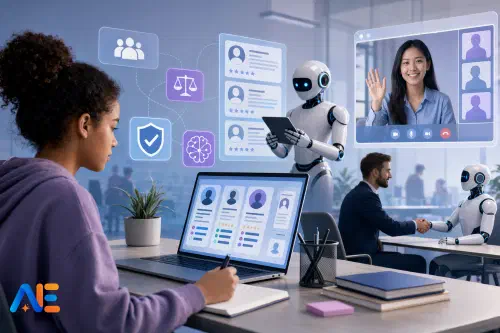
Careers education needs an AI hiring update now because recruitment is no longer just a conversation between a person and an employer. In many sectors, applicants use AI to draft CVs, refine cover letters and practise interview answers, while employers use AI to screen applications, summarise interviews and rank candidates. That means students are entering a process in which software may shape both what they submit and how they are judged.
For schools and colleges, this is not a niche issue for future technologists. It belongs in mainstream careers guidance, sixth-form tutoring and employability work. The same broader questions appearing in teaching and assessment now also appear in recruitment: when is AI support helpful, when does it distort evidence, and how do we protect fairness? Those concerns connect closely with wider debates about AI and assessment integrity, because hiring increasingly raises similar questions about authorship, authenticity and trust.
Agent-to-agent recruitment
Agent-to-agent recruitment sounds futuristic, but parts of it already exist. A student may use an AI assistant to tailor a CV to a job advert, generate likely interview questions and rehearse responses. On the employer side, an applicant tracking system may scan that CV for keywords, score it against a job description and invite the candidate to a one-way video interview. Another system may then transcribe the recording, summarise key points and flag strengths or concerns for a recruiter.
In practice, this means a student’s first audience may not be a person at all. Their carefully chosen examples could be shortened by a summariser. Their speech could be filtered through automatic transcription. Their application may be compared against patterns rather than read in full. Careers education should help students understand this without becoming cynical. The aim is not to frighten them, but to make the process visible.
Where students meet AI
Students now meet AI in hiring at several points. The most obvious is application writing. Many use tools to improve phrasing, structure examples and match the tone of a role. Less obvious are AI-powered job-matching systems, automated skills tests, chatbot pre-screening, asynchronous video interviews and post-interview summaries.
A useful classroom discussion is to ask, “Where might a machine make a decision before a human sees anything?” That question helps students identify hidden stages in recruitment. It also builds the sort of critical AI literacy that teachers are already developing through comparison and evaluation tasks, much like the habits encouraged when students examine how different AI systems respond to the same prompt in classroom comparison work.
Video interviews and transcription
AI video interviews deserve special attention because they can disadvantage students in uneven ways. A one-way interview, in which a candidate records answers alone against a timer, already changes the social demands of interviewing. Add AI transcription and analysis, and the risks increase. Students may assume they are being judged only on content, but they may also be affected by microphone quality, background noise, accent recognition and how accurately their speech is transcribed.
This matters especially for non-native speakers. A student may give a strong answer, but if key words are transcribed incorrectly, the summary produced for a recruiter may misrepresent what they said. Even a small transcription error can alter meaning. A phrase about “leading a team” might become “learning in a team”, or a technical term may be replaced with something meaningless. If the system then extracts themes from that faulty transcript, the error multiplies.
Schools should teach students to prepare for this reality in practical ways. They can practise speaking clearly without demanding accent conformity. They can test microphones, reduce background noise and learn to pause between ideas. They should also know that accessibility and language fairness are legitimate concerns to raise. Work on voice AI, fluency and accessibility offers a useful parallel here: speech technologies can support users, but they can also misread them.
CVs and cover letters
Careers education should not simply tell students, “Do not use AI.” That advice is unrealistic and unhelpful. Instead, students need to learn what good use looks like. AI can help them spot missing evidence, tighten layout, remove repetition and adapt tone for a sector. It should not invent experience, exaggerate impact or produce generic claims the student cannot defend in an interview.
A good rule is that every sentence on a CV or cover letter must remain fully explainable by the student. If an AI tool improves the wording of a statement about teamwork, the student should still be able to describe the original event, what they did, what challenge they faced and what changed as a result. If they cannot, the application has become performance rather than evidence.
This is where careers education can borrow from AI-resilient assessment design. In both classrooms and hiring, the strongest evidence usually comes from specifics: named projects, measurable outcomes, reflective detail and examples that can be expanded under questioning. Generic polish is now cheap. Concrete evidence is not.
Showing genuine skills
When AI helps everyone polish their writing, genuine skills become more important, not less. Students need to understand that employers may increasingly value live demonstration, portfolio evidence and detailed discussion of process. That could include showing code, explaining design decisions, talking through customer service scenarios, discussing a group project or reflecting on what went wrong and what they learned.
Teachers can help by shifting employability preparation away from surface presentation alone. A mock interview should not only ask for polished answers. It should also ask follow-up questions that test ownership: “What exactly did you do?” “Why did you choose that approach?” “What would you change next time?” Those questions reveal whether a student has real experience behind a polished application.
Discover the power of Automated Education by joining out community of educators who are reclaiming their time whilst enriching their classrooms. With our intuitive platform, you can automate administrative tasks, personalise student learning, and engage with your class like never before.
Don’t let administrative tasks overshadow your passion for teaching. Sign up today and transform your educational environment with Automated Education.
🎓 Register for FREE!
Fairness and accessibility
Students should leave careers lessons knowing which questions are reasonable to ask employers. If an organisation uses AI in screening or interviewing, applicants may need to know whether there is human review, whether adjustments are available and how to report a problem. A student with a speech difference, unstable internet access or concerns about transcription should know that asking for support is not a sign of weakness.
Useful questions include whether answers are reviewed by a person, whether transcripts can be corrected, whether alternative interview formats exist and how personal data is stored. These are not niche issues. They sit alongside the wider safeguarding, policy and accountability questions schools are already discussing in whole-school AI planning and staff training.
A practical lesson sequence
For careers leads, tutors and sixth-form teams, a simple lesson sequence works well. Begin with a sample vacancy and ask students to identify where AI may appear in the hiring process. Next, show two versions of a CV paragraph: one generic and polished, one specific and evidence-rich. Ask which would survive a follow-up interview. Then run a mock asynchronous video interview using short, timed responses, followed by transcript checking. If possible, deliberately include examples where transcription software mishears names, technical terms or accented speech. Students quickly see that “the transcript” is not always “the truth”.
After that, move into application drafting. Let students use AI to improve structure, but require them to annotate each paragraph with the real experience behind it. Finish with a reflection task: what help from AI felt fair, what felt risky, and what would they disclose or clarify if asked? This keeps the lesson practical rather than abstract.
Parents and employers
Parents and carers often need reassurance as much as students do. Many worry that AI means traditional effort no longer matters, or that every application has become a contest of prompt writing. Schools can explain that the core employability habits remain stable: clear communication, honest evidence, preparation, reflection and adaptability. AI changes the medium, not the value, of those habits. A short briefing or information evening can help, especially if it builds on approaches like the AI parent consultation workflow.
Employers can help too. Schools should encourage local partners to be transparent about where AI is used and to review whether their systems create barriers for multilingual applicants or those with access needs. A fair recruitment process is not only efficient; it is more likely to identify real talent.
A student checklist
A short checklist can give students something memorable to carry into applications. Keep it simple. Use AI to improve clarity, not to invent substance. Keep copies of your original drafts. Practise speaking clearly for video, but do not erase your identity. Test your audio and internet setup. Be ready to explain every claim on your CV. Build a portfolio of real evidence. Ask about adjustments if needed. If a transcript or process seems wrong, say so promptly and professionally.
The deeper message is that students should not see themselves as passive subjects of an automated process. They still have agency. They can prepare intelligently, question unfair systems and present authentic evidence of what they can do.
Careers education has always adapted to changing labour markets. This is simply the next version of that task. The schools that respond best will not teach students to fear AI or worship it. They will teach them to understand it, use it carefully and recognise when fairness needs defending.
Wishing you confidence in every next-step conversation.
The Automated Education Team