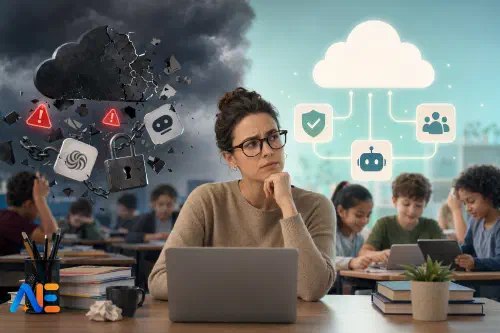
The promise faded
For a while, free AI looked like a gift to schools. A teacher could open a browser, ask for a worksheet, tidy a parent email, or summarise a policy in seconds. Department heads could experiment without waiting for a budget meeting. Leaders could tell themselves they were being prudent by avoiding subscriptions altogether.
That era is ending. Schools that still rely on free consumer AI are now building on sand. The issue is not simply that some free tools are less generous than before. It is that the whole model has become unstable. If your staff depend on a free tier for routine planning, reporting or communication, you no longer have a savings strategy. You have an operational risk. This is becoming clearer each time a provider adds adverts, changes limits or quietly weakens access, as discussed in this briefing on the end of free forever.
What changed
The shift has happened in several ways at once. First, adverts are creeping into consumer AI experiences. Even when they seem harmless, they change the character of the tool. A school cannot sensibly build staff routines around a platform whose interface may be shaped by commercial prompts rather than educational reliability.
Second, lockouts are more common. A teacher who used a free tool last week may find today that a feature has moved behind a paywall, a rate limit has been hit, or access is restricted in their region. That matters when a lesson starts in ten minutes.
Third, usage caps have shrunk. Free tiers often give just enough access to create dependence, then become frustrating once staff use them regularly. A one-off experiment is easy; a week of report drafting, meeting summaries and revision support is not.
Finally, silent model switching has become a serious problem. A free service may look identical from one day to the next, but the quality, speed or behaviour underneath can change without warning. If your English department has tuned a feedback workflow around one level of output, and the model suddenly becomes weaker or more erratic, the workflow breaks. Schools need consistency more than novelty. That is why many leaders are now comparing paid access more carefully, including lighter options such as those covered in this look at Gemini 3.1 Flash Lite.
A governance problem
It is tempting to say, “Just use the free version unless it stops working.” That sounds thrifty, but it creates a governance issue. When staff rely on unmanaged consumer tools, leaders lose oversight of data handling, retention, account ownership and continuity. Even if no sensitive data is entered, the school still faces inconsistency, uneven access and poor auditability.
This is the key change for 2026. The question is no longer whether free AI can sometimes help. Of course it can. The real question is whether a school should allow essential work to depend on services it does not control and cannot predict. Once AI becomes part of everyday operations, procurement and governance have to catch up.
A useful way to frame this is simple: if a workflow matters enough to be repeated, it matters enough to be stabilised. That is why schools reviewing AI use should connect procurement to privacy and retention checks, rather than treating them as separate conversations. An end-of-term AI privacy audit often reveals just how much routine work has drifted onto informal tools.
Critical workflows
Some school tasks are too important to run on unstable consumer access. Report drafting is one. If staff use AI to structure comments, standardise tone or reduce repetition, they need predictable output and dependable availability. The same is true for meeting note summarisation, policy redrafting, classroom resource adaptation and transcript-based revision materials.
Classroom preparation is especially vulnerable. A teacher may use AI to simplify a text, generate retrieval questions or create model answers at short notice. If the free tier slows down, inserts friction or changes quality on a busy morning, the impact is immediate. The cost of failure is not just inconvenience. It is lost preparation time, staff frustration and a growing sense that AI cannot be trusted.
Transcription is another example. If pastoral meetings, CPD sessions or department reviews depend on automatic notes, a free tool with shrinking quotas is not good enough. The same goes for image support used in slides, displays or visual scaffolds. These are not glamorous use cases, but they are exactly where reliability pays for itself.
What paid should cover
A minimum viable paid AI stack does not mean buying the most powerful subscription for every member of staff. In many schools, that would be wasteful. Instead, it means paying for stability in the handful of functions that support real work.
For most schools in 2026, that stack has five core functions: drafting, summarising, classroom preparation, transcription and image support. Drafting covers emails, policies, letters, reports and planning documents. Summarising covers meetings, research, long policies and student information. Classroom preparation includes differentiated questions, examples, quizzes and simplified texts. Transcription supports meetings and recorded content. Image support helps with visual explanations and presentation materials.
The smartest low-budget setups separate these functions rather than forcing one expensive flagship tool to do everything. A lightweight paid text model may be enough for 80 per cent of drafting and summarising. A separate transcription service may be cheaper and more reliable than using a premium all-in-one assistant. In practice, many schools will get better value by matching tools to tasks than by buying a single top-tier subscription because it sounds impressive. That is also why reality checks matter more than launch hype, as explored in this teacher workflow test of GPT-5.4.
Discover the power of Automated Education by joining out community of educators who are reclaiming their time whilst enriching their classrooms. With our intuitive platform, you can automate administrative tasks, personalise student learning, and engage with your class like never before.
Don’t let administrative tasks overshadow your passion for teaching. Sign up today and transform your educational environment with Automated Education.
🎓 Register for FREE!
Smaller models, better value
There is a growing case for lightweight paid models over flagship subscriptions. If the task is turning rough notes into a clean parent email, summarising a ten-page policy, or producing a first draft of cover work, speed and cost matter more than elite reasoning benchmarks. Smaller models are often faster, cheaper and easier to scale across a department.
That does not mean premium models have no place. Senior leadership, SEND documentation, complex policy drafting or multi-step analysis may justify stronger tools for a small number of users. But many schools overspend when they assume every AI task needs the best available model. In reality, a mixed stack often works better: lighter paid access for most staff, stronger access for a few advanced users, and clear rules about which tool is used for which purpose.
Open-source limits
Open-source and self-hosted options deserve a place in the conversation, especially for schools with strong technical support or strict data requirements. They can reduce dependence on consumer platforms and may offer more control over deployment. But they are not a universal escape route.
Self-hosting brings infrastructure, maintenance, monitoring and support burdens. A school that struggles to manage printer fleets is unlikely to enjoy running local AI services. Open models can be excellent for some tasks, but they still need evaluation, safeguarding and technical due diligence. For many small schools, open source is best treated as a targeted option for specific needs rather than a whole-school default. Leaders considering that route should read both this self-hosting decision framework and this broader open-source procurement checklist.
Budget with discipline
For stretched schools and departments, the budgeting principle is straightforward: pay first for continuity, not prestige. Protect the workflows that save time every week. Start with a small number of named users or shared functional accounts, where policy allows. Review actual usage after a month, then expand only where the gains are clear.
It also helps to budget by function. Ask how much the school can justify each month for reliable drafting, reliable transcription and reliable classroom preparation. That keeps the conversation grounded in outcomes rather than brand names. A low-cost stack that consistently saves six teachers twenty minutes a day is worth more than a premium subscription that few staff fully use.
Procurement checks
Before moving off free tiers, schools should complete a few basic checks. Can the provider state where data is processed? Are there regional restrictions? Can accounts be managed centrally? Is there a clear export and deletion process? What happens if the model or pricing changes mid-year? These questions are increasingly important as providers vary access by geography and product line. A sensible next step is to use a structured review such as this 12-question renewal checklist.
A 30-day transition
A 30-day move away from free dependence is realistic. In week one, audit where staff already rely on free AI, even informally. In week two, identify the two or three workflows that matter most and choose paid tools for those first. In week three, pilot with a small group of staff and document approved uses. In week four, switch those workflows to paid access, withdraw recommendations for unstable free tools and set a review date.
This does not require a grand transformation plan. It requires honesty. Free consumer AI is no longer stable enough to underpin important school work. A minimum viable paid stack is not about buying more technology for its own sake. It is about reducing friction, protecting staff time and bringing everyday AI use into a manageable, governable shape.
The schools that handle this well in 2026 will not be the ones with the biggest AI budget. They will be the ones that stop pretending free access is still a dependable foundation.
Here’s to steadier systems and fewer unpleasant surprises.
The Automated Education Team