A harder test
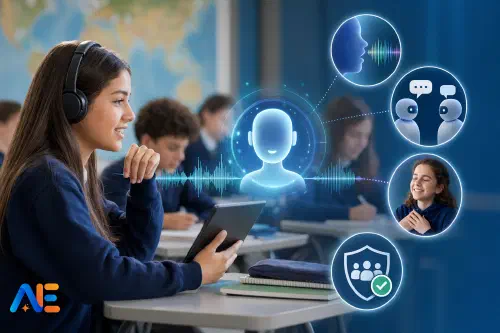
AI voice demos often look impressive in modern foreign languages. A tool greets the user in French, responds smoothly in Spanish, or offers instant pronunciation scoring in German. On screen, it can feel like the long-promised speaking partner teachers have wanted for years. Yet MFL classrooms are a much harder test than polished demos. In school, the question is not whether a model can speak. It is whether it can support learning safely, consistently, and usefully for pupils of different ages, confidence levels, and language backgrounds.
That is why voice AI needs a classroom-first evaluation rather than a marketing-first one. Departments that are already reviewing tools through a wider lens may find it helpful to pair this discussion with a broader AI audit scorecard for departments. Speaking practice is especially demanding because weak performance shows up quickly. If feedback is vague, pupils get confused. If turn-taking feels awkward, the dialogue collapses. If the tool sounds too fluent or too forgiving, hesitant speakers may leave with misplaced confidence rather than better language.
Four classroom tests
In 2026, the most useful way to judge AI voice tools for MFL is against four adoption tests.
The first is pronunciation feedback. Can the tool identify what a pupil actually needs to improve, or does it simply reward anything that sounds close enough? The second is turn-taking. Can a pupil sustain a realistic exchange, with interruptions, hesitation, and repair, or is the conversation only smooth when the pupil speaks in perfect chunks? The third is confidence. Does the tool lower the emotional barrier for reluctant speakers, or does it create a private but unhelpful rehearsal loop? The fourth is safeguarding. Can the tool operate within clear, age-appropriate boundaries, especially for younger learners who still need teacher-led structure?
These tests matter because MFL speaking is not just output. It is interaction, risk-taking, and correction. A Year 8 pupil rehearsing a café role-play needs different support from an older student preparing a more extended discussion. The technology may be the same, but the classroom expectations are not.
What we judged
When testing 2026 voice modes, the most sensible approach was not to ask which tool sounded most human. That is interesting, but not enough. Instead, we looked at whether a tool could handle realistic classroom tasks. Could it support a beginner ordering food, an intermediate learner describing a weekend, or a more advanced pupil defending an opinion? Could it cope with accent variation, background noise, and incomplete answers? Could it stay within a narrow task without drifting into unsuitable topics or overly complicated language?
This kind of testing works best when schools are clear about procurement, availability, and compliance from the start. For that reason, some leaders may also want to review a school AI renewal checklist for 2026, especially where voice features vary by region or account type. A tool that performs well in a trial but cannot be deployed consistently across classes is not yet classroom-ready.
Feedback that helps
Pronunciation feedback is where voice AI has improved most visibly by 2026. The better systems can now flag stress, vowel length, missing sounds, and intonation patterns with more precision than earlier versions. For a pupil practising short phrases, this can be genuinely useful. A learner saying a French sentence can repeat it several times without feeling they are holding up the class. A shy student can try a Spanish response privately before speaking aloud to a partner. That low-friction repetition is valuable.
Still, helpful feedback depends on clarity. The strongest tools do not just say, “Try again”, or produce a mysterious score out of ten. They point to a specific issue in simple language. For example, they might explain that the final consonant was pronounced when it is often silent, or that the stress fell on the wrong syllable. That sort of guidance supports improvement.
The problem comes when systems overclaim. Some tools still treat pronunciation as if there is one correct accent and one correct rhythm. Others mistake intelligible variation for error, or worse, accept unclear speech because the language model has guessed the intended phrase. In practice, this means pupils may receive praise for speech that would puzzle a real listener, or correction for speech that is perfectly acceptable in context. Teachers therefore need to frame AI feedback as provisional, not authoritative. It can support practice, but it should not replace teacher modelling and live listening.
Better dialogue?
Turn-taking remains the more difficult test. Many 2026 voice tools are much faster than before. Delays are shorter, interruptions are handled more naturally, and filler language no longer causes immediate breakdown. That is real progress. In a simple role-play, pupils can often sustain a short exchange that feels more like conversation and less like reading into a microphone.
Even so, classroom dialogue is messy in ways AI still finds hard. Pupils restart sentences, ask for repetition, drift into English, laugh, whisper, and change direction halfway through an answer. A natural conversation partner handles this flexibly while keeping the exchange comprehensible. Voice AI can now manage some of that, but not all of it. It often works best in tightly framed tasks: booking a room, introducing yourself, ordering lunch, or describing a picture. Once the task becomes more open, the model may simplify too much, lead the pupil too heavily, or move on before the learner has fully responded.
This matters because sustained dialogue is a core speaking skill. If the system constantly rescues the pupil, the pupil is not really learning to manage interaction. Departments already comparing classroom tools critically may recognise this pattern from other products, as discussed in a one-week reality check on teacher workflow tests. A smooth first impression is not the same as reliable day-to-day use.
Confidence and caution
For reluctant speakers, voice AI can be surprisingly effective. Some pupils will speak more readily to a non-judgemental tool than to a classmate or teacher. They know they can pause, repeat themselves, and start again without social embarrassment. In that sense, these tools can create a low-stakes rehearsal space. A nervous learner who rarely volunteers in class may arrive at paired speaking with a little more fluency and a little less fear.
Discover the power of Automated Education by joining out community of educators who are reclaiming their time whilst enriching their classrooms. With our intuitive platform, you can automate administrative tasks, personalise student learning, and engage with your class like never before.
Don’t let administrative tasks overshadow your passion for teaching. Sign up today and transform your educational environment with Automated Education.
🎓 Register for FREE!
But confidence-building is not the same as competence-building. If the system is too supportive, pupils may mistake a successful interaction with AI for readiness in a live classroom exchange. The danger is false reassurance. A pupil may perform well because the tool accepts fragmented language, narrows the topic, or infers meaning generously. Then the same pupil struggles when a real person responds unpredictably. The best use, therefore, is rehearsal before human interaction, not replacement of it. AI can help pupils get to the starting line; it should not become the race itself.
Safeguarding first
Safeguarding is the area where schools must stay most disciplined. Younger learners, in particular, need clearly bounded tasks, visible supervision, and age-appropriate settings. Voice tools should not be treated as open conversational companions. They should be configured, where possible, for narrow educational purposes with strict topic limits, short sessions, and teacher-defined prompts. If those controls are unavailable, the tool is a poor fit for routine use with children.
This is not only about inappropriate content. It is also about emotional framing, data handling, and dependency. A voice system that sounds warm and personal can encourage children to treat it as a confidant rather than a practice tool. That is not a small design issue. It changes how pupils relate to the technology. Schools should therefore review voice tools alongside a wider safeguarding pre-flight checklist for AI chatbots and ensure staff understand where teacher-led boundaries must remain firm.
In practical terms, teacher-led elements should include task selection, language targets, session length, review of outputs, and follow-up correction. For many primary and lower-secondary settings, that means using voice AI only as a supervised station activity or homework extension with very clear guardrails. Staff training matters here too, and departments may benefit from a short AI safety pack for educators before any wider rollout.
Best-fit use cases
So where do 2026 voice tools fit best? They are strongest with older primary pupils and secondary learners when tasks are short, structured, and closely tied to current classroom content. They work well for pronunciation rehearsal, transactional dialogues, confidence-building warm-ups, and repeated practice of familiar sentence patterns. They are less reliable for nuanced spontaneous discussion, high-stakes assessment preparation without teacher moderation, or independent use by younger pupils in open-ended conversation mode.
Language level matters as much as age. Beginners often benefit because the task can be tightly controlled. Intermediate learners can benefit too, but only if prompts are calibrated carefully. More advanced students may enjoy the fluency, yet they are also more likely to notice the limits: shallow follow-up questions, over-accommodation, and occasional inaccuracies. As with AI-resilient assessment design, the key is matching the task to what the tool can genuinely support.
A simple pilot
If an MFL department wants to pilot voice AI, it helps to keep the first trial modest. Choose one year group, one language, and one narrow speaking task. Decide in advance what success looks like. Is it better pronunciation? More speaking turns? Greater willingness to participate? Then compare pupil performance with and without the tool. Gather short teacher observations, not just pupil enthusiasm. Excitement is common in the first week; sustained learning gains are the real measure.
It is also wise to agree stopping rules before the pilot begins. If feedback is misleading, if safeguarding settings prove weak, or if classroom management becomes harder rather than easier, pause the rollout. A disciplined pilot tells you more than a broad but vague launch.
Final verdict
Are AI voice tools for MFL finally good enough for speaking practice in 2026? In tightly defined conditions, yes. They are now genuinely useful for pronunciation rehearsal, short structured dialogues, and helping hesitant speakers practise before speaking to people. That is a meaningful step forward.
But they are not yet a general substitute for teacher-led speaking work, peer interaction, or live corrective feedback. Their value depends on careful task design, realistic expectations, and firm safeguarding boundaries. Used narrowly and well, they can earn a place in the MFL toolkit. Used loosely, they can create confusion, overconfidence, and unnecessary risk.
For most departments, the right verdict is not wholehearted adoption or blanket rejection. It is selective use with clear limits, close monitoring, and a constant focus on real classroom learning.
May your next speaking lesson feel a little less daunting and a lot more purposeful.
The Automated Education Team